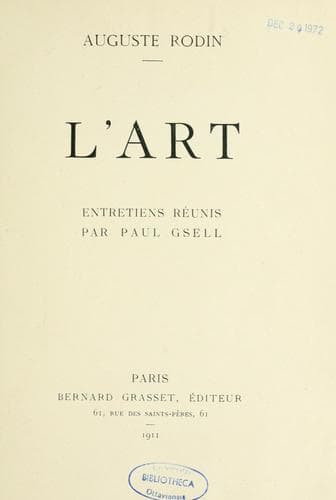
Art; Artists; Artists -- France -- Interviews; Sculpture
“Yes, doubtless.” Then, with a shade of irony, “But the greatest
difficulties for the artist who models a bust or who paints a portrait
do not come from the work which he executes. They come from the client
for whom he works. By a strange and fatal law, the one who orders his
own likeness is the one who always desperately combats the talent of the
artist he has chosen. It is very seldom that a man sees himself as he
is, and even if he knows himself, he does not wish the artist to
represent him as he is. He asks to be represented under the most banal
and neutral aspect. He wishes to be an official or worldly marionette.
It pleases him to have the function he exercises, the rank he holds in
society, completely efface the man that is in him. The magistrate wishes
his robe, the general his gold-laced tunic. They care very little
whether one can read their characters.
“This explains the success of so many mediocre painters and sculptors
who are satisfied to give the impersonal appearance of their clients:
their gold lace and their official attitude. These are the artists who
are generally highest in favor because they lend their models a mask of
riches and importance. The more bombastic a portrait is, the more it
resembles a stiff, pretentious doll, the better the client is satisfied.
[Illustration:
FRANCIS I
By Titian
]
“Perhaps it was not always so.
“Certain seigneurs of the fifteenth century, for example, seem to have
been pleased to see themselves portrayed as hyenas or vultures on the
medals of Pisanello. They were doubtless proud of their individuality.
Or, better still, they loved and venerated art, and they accepted the
rude frankness of the artist, as though it were a penance imposed by a
spiritual director.
“Titian did not hesitate to give Pope Paul III. a marten’s snout, nor to
emphasize the domineering hardness of Charles V., or the salaciousness
of Francis I., and it does not appear to have damaged his reputation
with them. Velasquez, who portrayed King Philip IV. as a nonentity,
though an elegant man, and who unflatteringly reproduced his hanging
jaw, nevertheless kept his favor. And the Spanish monarch has acquired
from posterity the great glory of having been the protector of genius.
“But the men of to-day are so made that they fear truth and love a lie.
They seem to be displeased to appear in their busts as they are. They
all want to have the air of hairdressers.
“And even the most beautiful women, that is to say, those whose lines
have most style, are horrified at their own beauty when a sculptor of
talent is its interpreter. They beseech him to make them ugly by giving
them an insignificant and doll-like physiognomy.
“So, to execute a bust is to fight a long battle. The one thing that
matters is not to weaken and to rest honest with one’s self. If the work
is refused, so much the worse. So much the better perhaps; for often, it
proves that it is full of merit.
Public-domain text, read in full here on John Shaqi.
Reviews
Reviews
No reviews yet
Be the first to share your thoughts on this work.
Join the Discussion
Join the discussion
Sign in to leave a comment or review.
Sign InorCreate an account