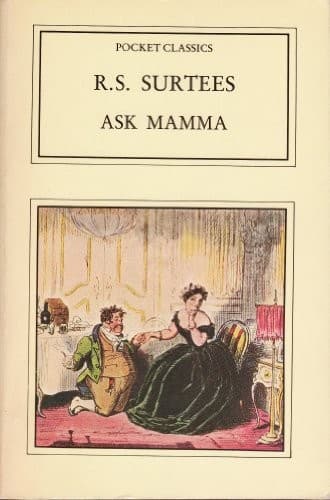
"Ask Mamma"; or, The Richest Commoner In EnglandSurtees, Robert Smith
General
"Ask Mamma"; or, The Richest Commoner In England
Surtees, Robert Smith
England -- Social life and customs -- 19th century -- Fiction; Fox hunting -- Fiction
Billy—old Billy that is to say—was quite struck in a heap at such
an unwonted apparition, and after the then usual salutations, and
inquiries how she would like to have the window, he popped the
old question, “How far was she going?” with very different
feelings to what it was generally asked, when the traveller
wished to calculate how soon he might hope to get rid of his
_vis-à-vis_ and lay up his legs on the seat.
“To town,” replied the lady, dimpling her pretty cheeks with a
smile. “And you?” asked she, thinking to have as good as she
gave.
“Ditto,” replied the delighted Billy, divesting himself of a
great coarse blue and white worsted comforter, and pulling up his
somewhat dejected gills, abandoning the idea of economising his
Lincoln and Bennett by the substitution of an old Gregory’s
mixture coloured fur cap, with its great ears tied over the top,
in which he had snoozed and snored through many a long journey.
Miss Willing then drew from her richly-buckled belt a beautiful
Geneva watch set round with pearls, (her ladyship’s, which she
was taking to town to have repaired), and Billy followed suit
with his substantial gold-repeater, with which he struck the
hour. Miss then ungloved the other hand, and passed it down her
glossy brown hair, all smooth and regular, for she had just been
scrutinising it in a pocket-mirror she had in her
gold-embroidered reticule.
Billy’s commercial soul was in ecstacies, and he was fairly over
head and ears in love before they came to the first change of
horses. He had never seen sich a sample of a hand before, no, nor
sich a face; and he felt quite relieved when among the
multiplicity of rings he failed to discover that thin plain gold
one that intimates so much.
Whatever disadvantages old stage coaches possessed, and their
name certainly was legion, it must be admitted that in a case of
this sort their slowness was a recommendation. The old True Blue
Independent did not profess to travel or trail above eight miles
an hour, and this it only accomplished under favourable
circumstances, such as light loads, good roads, and stout steeds,
instead of the top-heavy cargo that now ploughed along the woolly
turnpike after the weak, jaded horses, that seemed hardly able to
keep their legs against the keen careering wind. If, under such
circumstances, the wretched concern made the wild-beast-show
looking place in London, called an inn, where it put up, an hour
or an hour and a half or so after its time, it was said to be all
very well, “considering,”—and this, perhaps, in a journey of
sixty miles.
Public-domain text, read in full here on John Shaqi.
Reviews
Reviews
No reviews yet
Be the first to share your thoughts on this work.
Join the Discussion
Join the discussion
Sign in to leave a comment or review.
Sign InorCreate an account