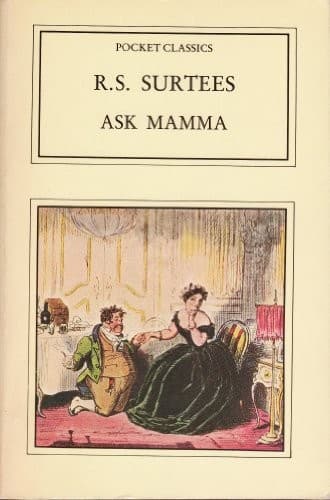
"Ask Mamma"; or, The Richest Commoner In EnglandSurtees, Robert Smith
General
"Ask Mamma"; or, The Richest Commoner In England
Surtees, Robert Smith
England -- Social life and customs -- 19th century -- Fiction; Fox hunting -- Fiction
shire Baronet at Pangburn Park, expecting she would be very much
pleased and struck with the increased consequence. Instead of
which, however, though Mrs. Pringle felt that he had perhaps hit
upon the lesser evil, she wrote him a very loving letter by
return of post, saying she was glad to hear he was enjoying
himself, but cautioning him against “Moses Mainchance” (omitting
the Sir), adding that every man’s character was ticketed in
London, and the letters “D. D.” for “Dirty Dog” were appended to
his. She also told him that uncle Jerry had been inquiring about
him, and begging she would call upon him at an early day on
matters of business, all of which will hereafter “more full and
at large appear,” as the lawyers say; meanwhile, we must back the
train of ideas a little to our hero. Just as he was affixing the
great seal of state to the letter, Cuddy Flintoff’s “for-rard on!
for-rard on!” was heard progressing along the passage, followed
by a noisy knock, with an exclamation of “Pringle” at our
friend’s door.
“Come in!” cried he; and in obedience to the invitation, Flintoff
stood in the doorway. “Don’t forget,” said he, “that we dine at
Hinton to-day, and the Baronet’s ordered the trap at four,”
adding, “I’m going to dress, and you’d better do the same.” So
saying, Cuddy closed the door, and hunted himself along to his
own room at the end of the passage—“_E’leu in there! E’leu in!_”
oried he as he got to the door.
Hinton, once the second town in Hit-im and Hold-im shire, stands
at the confluence of the Long Brawlinerford and Riplinton brooks,
whose united efforts here succeed in making a pretty respectable
stream. It is an old-fashioned country place, whose component
parts may be described as consisting of an extensive
market-place, with a massive church of the florid Gothic, or
gingerbread order of architecture at one end, a quaint
stone-roofed, stone-pillared market cross at the other, the Fox
and Hounds hotel and posting-house on the north side, with
alternating shops and public houses on the south.
Its population, according to a certain “sore subject”
topographical dictionary, was 23,500, whilst its principal trade
might have been described as “fleecing the foxhunters.” That was
in its golden days, when Lord Martingal hunted the country,
holding his court at the Fox and Hounds hotel, where gentlemen
stayed with their studs for months and months together, instead
of whisking about with their horses by steam. Then every stable
in the town was occupied at very remunerative rents, and the
inhabitants seemed to think they could never build enough.
Public-domain text, read in full here on John Shaqi.
Reviews
Reviews
No reviews yet
Be the first to share your thoughts on this work.
Elsewhere in the archive
Join the Discussion
Join the discussion
Sign in to leave a comment or review.
Sign InorCreate an account