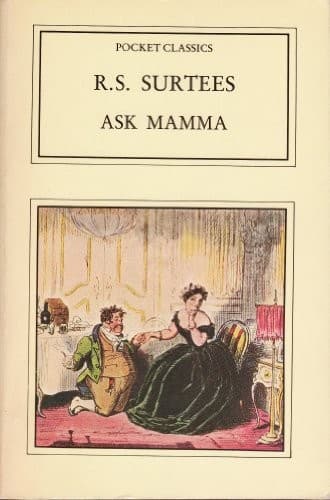
"Ask Mamma"; or, The Richest Commoner In EnglandSurtees, Robert Smith
General
"Ask Mamma"; or, The Richest Commoner In England
Surtees, Robert Smith
England -- Social life and customs -- 19th century -- Fiction; Fox hunting -- Fiction
Nature had favoured Billy’s pretensions in the lady-killing way.
In person he was above the middle height, five feet eleven or so,
slim and well-proportioned, with a finely-shaped head and face,
fair complexion, light brown hair, laughing blue eyes, with long
lashes, good eyebrows, regular pearly teeth and delicately
pencilled moustache. Whiskers he did not aspire to. Nor did Billy
abuse the gifts of Nature by disguising himself in any of the
vulgar groomy gamekeepery style of dress, that so effectually
reduce all mankind to the level of the labourer, nor adopt any of
the “loud” patterns that have lately figured so conspicuously in
our streets. On the contrary, he studied the quiet unobtrusive
order of costume, and the harmony of colours, with a view of
producing a perfectly elegant general effect. Neatly-fitting
frock or dress coats, instead of baggy sacks, with trouser legs
for sleeves, quiet-patterned vests and equally quiet-patterned
trousers. If he could only have been easy in them he would have
done extremely well, but there was always a nervous twitching,
and jerking, and feeling, as if he was wondering what people were
thinking or saying of him.
In the dress department he was ably assisted by his mother, a
lady of very considerable taste, who not only fashioned his
clothes but his mind, indeed we might add his person, Billy
having taken after her, as they say; for his father, though an
excellent man and warm, was rather of the suet-dumpling order of
architecture, short, thick, and round, with a neck that was
rather difficult to find. His name, too, was William, and some,
the good-natured ones again of course, used to say that he might
have been called “Fine Billy the first,” for under the auspices
of his elegant wife he had assumed a certain indifference to
trade; and when in the grand strut at Ramsgate or Broadstairs, or
any of his watering-places, if appealed to about any of the
things made or dealt in by any of the concerns in which he was a
“Co.,” he used to raise his brows and shrug his shoulders, and
say with a very deprecatory sort of air, “‘Pon my life, I should
say you’re right,” or “‘Deed I should say it was so,” just as if
he was one of the other Pringles,—the Pringles who have nothing
to do with trade,—and in noways connected with Pringle & Co.;
Pringle & Potts; Smith, Sharp & Pringle; or any of the firms that
the Pringles carried on under the titles of the original
founders. He was neither a tradesman nor a gentleman. The
Pringles—like the happy united family we meet upon wheels; the
dove nestling with the gorged cat, and so on—all pulled well
together when there was a common victim to plunder; and kept
Public-domain text, read in full here on John Shaqi.
Reviews
Reviews
No reviews yet
Be the first to share your thoughts on this work.
Join the Discussion
Join the discussion
Sign in to leave a comment or review.
Sign InorCreate an account