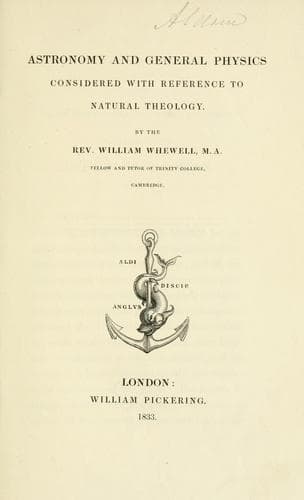
Astronomy and General Physics Considered with Reference to Natural TheologyWhewell, William
Religion
Astronomy and General Physics Considered with Reference to Natural Theology
Whewell, William
Astronomy; Cosmic physics; Natural theology
Laplace suggests that if the moon had been placed at a certain
distance beyond the earth, it would have revolved about the sun in
the same time as the earth does, and would have always presented
to us a full moon. For this purpose it must have been about four
times as far from us as it really is; and would therefore, other
things remaining unchanged, have only been _one sixteenth_ as
large to the eye as our present full moon. We shall not dwell on
the discussion of this suggestion, for the reason just intimated.
But we may observe that in such a system as Laplace proposes,
it is not yet proved, we believe, that the arrangement would be
stable under the influence of the disturbing forces. And we may add
that such an arrangement, in which the motion of one body has a
_co-ordinate_ reference to two others, as the motion of the moon on
this hypothesis would have to the sun and the earth, neither motion
being subordinate to the other, is contrary to the whole known
analogy of cosmical phenomena, and therefore has no claim to our
notice as a subject of discussion.
2. In turning our consideration to the satellites of the other
planets of our system, there is one fact which immediately arrests
our attention;--the number of such attendant bodies appears to
increase as we proceed to planets farther and farther from the
sun. Such at least is the general rule. Mercury and Venus, the
planets nearest the sun, have no such attendants: the Earth has
one. Mars, indeed, who is still farther removed, has none; nor
have the minor planets, Juno, Vesta, Ceres, Pallas; so that the
rule is only approximately verified. But Jupiter, who is at five
times the earth’s distance, has four satellites; and Saturn, who
is again at a distance nearly twice as great, has seven, besides
that most extraordinary phenomenon his ring, which, for purposes of
illumination, is equivalent to many thousand satellites. Of Uranus
it is difficult to speak, for his great distance renders it almost
impossible to observe the smaller circumstances of his condition.
It does not appear at all probable that he has a ring, like Saturn;
but he has at least five satellites which are visible to us, at the
enormous distance of nine hundred millions of miles; and we believe
that the astronomer will hardly deny that he may possibly have
thousands of smaller ones circulating about him.
Public-domain text, read in full here on John Shaqi.
Reviews
Reviews
No reviews yet
Be the first to share your thoughts on this work.
Elsewhere in the archive
Join the Discussion
Join the discussion
Sign in to leave a comment or review.
Sign InorCreate an account