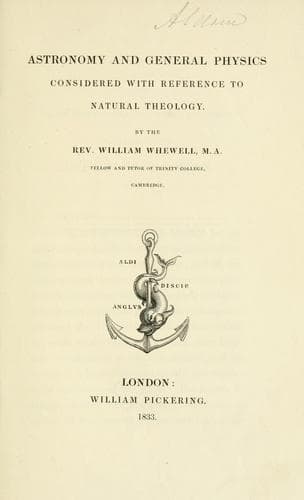
Astronomy and General Physics Considered with Reference to Natural TheologyWhewell, William
Religion
Astronomy and General Physics Considered with Reference to Natural Theology
Whewell, William
Astronomy; Cosmic physics; Natural theology
But leaving conjecture, and taking only the ascertained cases
of Venus, the Earth, Jupiter, and Saturn, we conceive that a
person of common understanding will be strongly impressed with
the persuasion that the satellites are placed in the system
with a view to compensate for the diminished light of the sun
at greater distances. The smaller planets, Juno, Vesta, Ceres,
and Pallas, differ from the rest in so many ways, and suggest so
many conjectures of reasons for such differences, that we should
almost expect to find them exceptions to such a rule. Mars is a
more obvious exception. Some persons might conjecture from his
case, that the arrangement itself, like other useful arrangements,
has been brought about by some wider law which we have not yet
detected. But whether or not we entertain such a guess, (it can be
nothing more,) we see in other parts of creation, so many examples
of apparent exceptions to rules, which are afterwards found to be
explained, or provided for by particular contrivances, that no one,
familiar with such contemplations, will, by one anomaly, be driven
from the persuasion that the end which the arrangements of the
satellites seem suited to answer is really one of the ends of their
creation.
CHAPTER VI.
_The Stability of the Ocean._
What is meant by the stability of the ocean may perhaps be
explained by means of the following illustration. If we suppose
the whole globe of the Earth to be composed of water, a sphere
of cork, immersed in any part of it, would come to the surface
of the water, except it were placed exactly at the centre of the
earth; and even if it were the slightest displacement of the cork
sphere would end in its rising and floating. This would be the case
whatever were the size of the cork sphere, and even if it were so
large as to leave comparatively little room for the water; and the
result would be nearly the same, if the cork sphere, when in its
central position, had on its surface prominences which projected
above the surface of the water. Now this brings us to the case in
which we have a globe resembling our present earth, composed like
it of water and of a solid centre, with islands and continents,
but having these solid parts all made of cork. And it appears by
the preceding reasoning, that in this case, if there were any
disturbance either of the solid or fluid parts, the solid parts
would rise from the centre of the watery sphere as far as they
could: that is, all the water would run to one side and leave the
land on the other. Such an ocean would be in _unstable_ equilibrium.
Public-domain text, read in full here on John Shaqi.
Reviews
Reviews
No reviews yet
Be the first to share your thoughts on this work.
Elsewhere in the archive
Join the Discussion
Join the discussion
Sign in to leave a comment or review.
Sign InorCreate an account