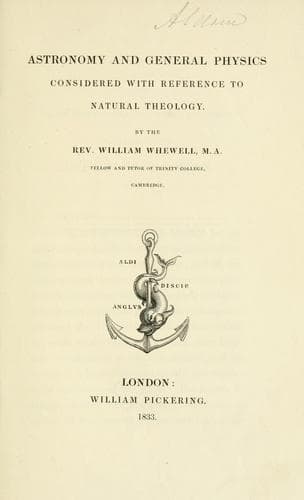
Astronomy and General Physics Considered with Reference to Natural TheologyWhewell, William
Religion
Astronomy and General Physics Considered with Reference to Natural Theology
Whewell, William
Astronomy; Cosmic physics; Natural theology
This argument is urged with great force by Newton himself. In his
first letter to Bentley, he allows that matter might form itself
into masses by the force of attraction. “And thus,” says he, “might
the sun and fixed stars be formed, supposing the matter were of
a lucid nature. But how the matter should divide itself into two
sorts; and that part of it which is fit to compose a shining body
should fall down into one mass, and make a sun; and the rest, which
is fit to compose an opaque body, should coalesce, not into one
great body, like the shining matter, but into many little ones; or
if the sun at first were an opake body like the planets, or the
planets lucid bodies like the sun, how he alone should be changed
into a shining body, whilst all they continue opake; or all they
be changed into opake ones, while he continued unchanged: I do not
think explicable by mere natural causes, but am forced to ascribe
it to the counsel and contrivance of a voluntary Agent.”
CHAPTER V.
_The Satellites._
1. A person of ordinary feelings, who, on a fine moonlight night,
sees our satellite pouring her mild radiance on field and town,
path and moor, will probably not only be disposed to “bless the
useful light,” but also to believe that it was “ordained” for that
purpose;--that the lesser light was made to rule the night as
certainly as the greater light was made to rule the day.
Laplace, however, does not assent to this belief. He observes,
that “some partisans of final causes have imagined that the moon
was given to the earth to afford light during the night:” but he
remarks that this cannot be so, for that we are often deprived at
the same time of the light of the sun and the moon; and he points
out how the moon might have been placed so as to be always “full.”
That the light of the moon affords, _to a certain extent_, a
supplement to the light of the sun, will hardly be denied. If
we take man in a condition in which he uses artificial light
scantily only, or not at all, there can be no doubt that the
moonlight nights are for him a very important addition to the time
of daylight. And as a small proportion only of the whole number
of nights are without some portion of moonlight, the fact that
sometimes both luminaries are invisible very little diminishes the
value of this advantage. Why we have not more moonlight, either in
duration or in quantity, is an inquiry which a philosopher could
hardly be tempted to enter upon, by any success which has attended
previous speculations of a similar nature. Why should not the moon
be ten times as large as she is? Why should not the pupil of man’s
eye be ten times as large as it is, so as to receive more of the
light which does arrive? We do not conceive that our inability
to answer the latter question prevents our knowing that the eye
was made for seeing: nor does our inability to answer the former,
disturb our persuasion that the moon was made to give light upon
the earth.
Public-domain text, read in full here on John Shaqi.
Reviews
Reviews
No reviews yet
Be the first to share your thoughts on this work.
Elsewhere in the archive
Join the Discussion
Join the discussion
Sign in to leave a comment or review.
Sign InorCreate an account