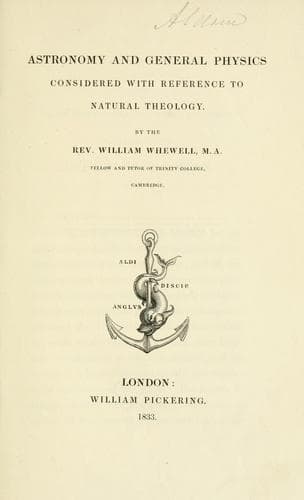
Astronomy and General Physics Considered with Reference to Natural TheologyWhewell, William
Religion
Astronomy and General Physics Considered with Reference to Natural Theology
Whewell, William
Astronomy; Cosmic physics; Natural theology
Our inland rivers would
probably never be able to reach the shores, but would be dried up
on their way, like those which run in torrid desarts; perhaps the
evaporation from the ocean would never reach the inland mountains,
and we should have no rivers at all. Without attempting to imagine
the details of such a condition, it is easy to see, that to secure
the existence of a different one is an end which is in harmony with
all that we see of the preserving care displayed in the rest of
creation.[20]
CHAPTER VII.
_The Nebular Hypothesis._
We have referred to Laplace, as a profound mathematician, who has
strongly expressed the opinion, that the arrangement by which
the stability of the solar system is secured is not the result
of chance; that “_a primitive cause_ has directed the planetary
motions.” This author, however, having arrived, as we have done,
at this conviction, does not draw from it the conclusion which has
appeared to us so irresistible, that “the admirable arrangement
of the solar system cannot but be the work of an intelligent and
most powerful being.” He quotes these expressions, which are
those of Newton, and points at them as instances where that great
philosopher had deviated from the method of true philosophy.
He himself proposes an hypothesis concerning the nature of the
_primitive cause_ of which he conceives the existence to be thus
probable: and this hypothesis, on account of the facts which it
attempts to combine, the view of the universe which it presents,
and the eminence of the person by whom it is propounded, deserves
our notice.
1. Laplace conjectures that in the original condition of the solar
system, the sun revolved upon his axis, surrounded by an atmosphere
which, in virtue of an excessive heat, extended far beyond the
orbits of all the planets, the planets as yet having no existence.
The heat gradually diminished, and as the solar atmosphere
contracted by cooling, the rapidity of its rotation increased by
the laws of rotatory motion, and an exterior zone of vapour was
detached from the rest, the central attraction being no longer able
to overcome the increased centrifugal force. This zone of vapour
might in some cases retain its form, as we see it in Saturn’s
ring; but more usually the ring of vapour would break into several
masses, and these would generally coalesce into one mass, which
would revolve about the sun. Such portions of the solar atmosphere,
abandoned successively at different distances, would form “planets
in the state of vapour.” These planets, it appears from mechanical
considerations, would have each its rotatory motion, and as the
cooling of the vapour still went on, would each produce a planet,
which might have satellites and rings, formed from the planet in
the same manner as the planets were formed from the atmosphere of
the sun.
Public-domain text, read in full here on John Shaqi.
Reviews
Reviews
No reviews yet
Be the first to share your thoughts on this work.
Elsewhere in the archive
Join the Discussion
Join the discussion
Sign in to leave a comment or review.
Sign InorCreate an account