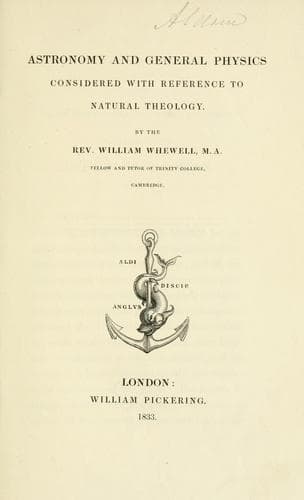
Astronomy and General Physics Considered with Reference to Natural TheologyWhewell, William
Religion
Astronomy and General Physics Considered with Reference to Natural Theology
Whewell, William
Astronomy; Cosmic physics; Natural theology
the young scholar first betrayed his inquisitive genius by asking
“And chaos whence?” When in his riper years he had persuaded
himself that this question was sufficiently answered by saying that
chaos arose from the concourse of atoms, it is strange that the
same inquisitive spirit did not again suggest the question “and
atoms whence?” And it is clear that however often the question
“whence?” had been answered, it would still start up as at first.
Nor could it suffice as an answer to say, that earth, chaos, atoms,
were portions of a series of changes which went back to eternity.
The preceptor of Epicurus informed him, that to be satisfied on the
subject of his inquiry, he must have recourse to the philosophers.
If the young speculator had been told that chaos (if chaos indeed
preceded the present order) was produced by an Eternal Being, in
whom resided purpose and will, he would have received a suggestion
which, duly matured by subsequent contemplation, might have led
him to a philosophy far more satisfactory than the material scheme
can ever be, to one who looks, either abroad into the universe, or
within into his own bosom.
CHAPTER IX.
_Mechanical Laws._
In the preceding observations we have supposed the laws, by which
different kinds of matter act and are acted upon, to be already in
existence; and have endeavoured to point out evidences of design
and adaptation, displayed in the selection and arrangement of these
materials of the universe. These materials are, it has appeared,
supplied in such measures and disposed in such forms, that by means
of their properties and laws the business of the world goes on
harmoniously and beneficially. But a further question occurs: how
came matter to have such properties and laws? Are these also to
be considered as things of selection and institution? And if so,
can we trace the reasons why the laws were established in their
present form; why the properties which matter actually possesses
were established and bestowed and bestowed upon it? We have already
attempted, in a previous part of this work, to point out some of
the advantages which are secured by the existing laws of heat,
light and moisture. Can we, in the same manner, point out the
benefits which arise from the present constitution of those laws
of matter which are mainly concerned in the production of cosmical
phenomena?
Public-domain text, read in full here on John Shaqi.
Reviews
Reviews
No reviews yet
Be the first to share your thoughts on this work.
Elsewhere in the archive
Join the Discussion
Join the discussion
Sign in to leave a comment or review.
Sign InorCreate an account