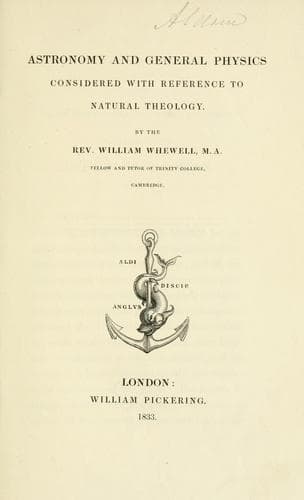
Astronomy and General Physics Considered with Reference to Natural TheologyWhewell, William
Religion
Astronomy and General Physics Considered with Reference to Natural Theology
Whewell, William
Astronomy; Cosmic physics; Natural theology
It will readily be perceived that the discussion of this point
must necessarily require some effort of abstract thought. The laws
and properties of which we have here to speak, the laws of motion
and the universal properties of matter, are so closely interwoven
with our conceptions of the external world, that we have great
difficulty in conceiving them not to exist, or to exist other than
they are. When we press or lift a stone, we can hardly imagine that
it could, by possibility, do otherwise than resist our effort by
its hardness and by its heaviness, qualities so familiar to us:
when we throw it, it seems inevitable that its motion should depend
on the impulse we give, just as we find that it invariably does.
Nor is it easy to say how far it is really possible to suppose
the fundamental attributes of matter to be different from what
they are. If we, in our thoughts, attempt to divest matter of its
powers of resisting and moving, it ceases to be matter, according
to our conceptions, and we can no longer reason upon it with any
distinctness. And yet it is certain that we can conceive the laws
of hardness and weight and motion to be quite different from what
they are, and can point out some of the consequences which would
result from such difference. The properties of matter, even the
most fundamental and universal ones, do not obtain by any absolute
necessity, resembling that which belongs to the properties of
geometry. A line touching a circle is _necessarily_ perpendicular
to a line drawn to the centre through the point touched; for
it may be shown that the contrary involves a contradiction. But
there is no contradiction in supposing that a body’s motion should
naturally diminish, or that its weight should increase in removing
further from the earth’s centre.
Thus the properties of matter and the laws of motion are what we
find them, not by virtue of any internal necessity which we can
understand. The study of such laws and properties may therefore
disclose to us the character of that external agency by which
we conceive them to have been determined to be what they are;
and this must be the same agency by which all other parts of the
constitution of the universe were appointed and ordered.
Public-domain text, read in full here on John Shaqi.
Reviews
Reviews
No reviews yet
Be the first to share your thoughts on this work.
Elsewhere in the archive
Join the Discussion
Join the discussion
Sign in to leave a comment or review.
Sign InorCreate an account