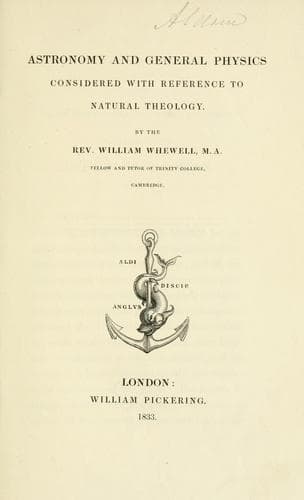
Astronomy and General Physics Considered with Reference to Natural TheologyWhewell, William
Religion
Astronomy and General Physics Considered with Reference to Natural Theology
Whewell, William
Astronomy; Cosmic physics; Natural theology
But we can hardly expect, with regard to such subjects, that
we shall be able to obtain any complete or adequate view of
the reasons why these general laws are so selected, and so
established. These laws are the universal basis of all operations
which go on, at any moment, in every part of space, with regard
to every particle of matter, organic and inorganic. All other
laws and properties must have a reference to these, and must be
influenced by them; both such as men have already discovered, and
the far greater number which remain still unknown. The general
economy and mutual relations of all parts of the universe, must
be subordinate to the laws of motion and matter of which we
here speak. We can easily suppose that the various processes of
nature, and the dependencies of various creatures, are affected
in the most comprehensive manner by these laws;--are simplified
by _their_ simplicity, made consistent by _their_ universality;
rendered regular by _their_ symmetry. We can easily suppose that
in this way there may be the most profound and admirable reasons
for the existence of the present universal properties of matter,
which we cannot apprehend in consequence of the limited nature
of our knowledge, and of our faculties. For, compared with the
whole extent of the universe, the whole aggregate of things and
relations and connexions which exist in it, our knowledge is
most narrow and partial, most shallow and superficial. We cannot
suppose, therefore, that the reasons which we discover for the
present form of the laws of nature go nearly to the full extent, or
to the bottom of the reasons, which a more complete and profound
insight would enable us to perceive. To do justice to such reasons,
would require nothing less than a perfect acquaintance with the
whole constitution of every part of creation; a knowledge which man
has not, and, so far as we can conceive, never can have.
We are certain, therefore, that our views, with regard to this
part of our subject, must be imperfect and limited. Yet still man
has _some_ knowledge with regard to various portions of nature;
and with regard to those most general and comparatively simple
facts to which we now refer, his knowledge is more comprehensive,
and goes deeper than it does in any other province. We conceive,
therefore, that we shall not be engaged in any rash or presumptuous
attempt, if we endeavour to point out some of the advantages which
are secured by the present constitution of some of the general
mechanical laws of nature; and to suggest the persuasion of that
purpose and wise design, which the selection of such laws will thus
appear to imply.
CHAPTER X.
_The Law of Gravitation._
Public-domain text, read in full here on John Shaqi.
Reviews
Reviews
No reviews yet
Be the first to share your thoughts on this work.
Elsewhere in the archive
Join the Discussion
Join the discussion
Sign in to leave a comment or review.
Sign InorCreate an account