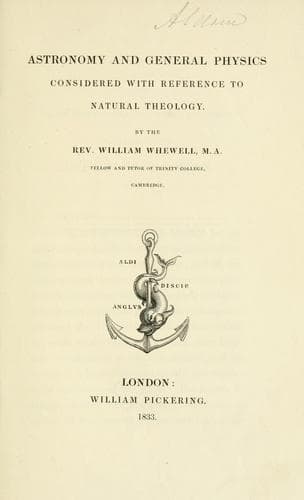
Astronomy and General Physics Considered with Reference to Natural TheologyWhewell, William
Religion
Astronomy and General Physics Considered with Reference to Natural Theology
Whewell, William
Astronomy; Cosmic physics; Natural theology
We shall proceed to make a few observations on the Law of Gravity,
in virtue of which the motions of planets about the sun, and of
satellites about their planets take place; and by which also are
produced the fall downwards of all bodies within our reach, and
the pressure which they exert upon their supports when at rest.
The identification of the latter forces with the former, and the
discovery of the single law by which these forces are every where
regulated, was the great discovery of Newton: and we wish to make
it appear that this law is established by an intelligent and
comprehensive selection.
The law of the sun’s attraction upon the planets is, that this
attraction varies _inversely_ as the square of the distance; that
is, it decreases as that square increases. If we take three points
or planets of the solar system, the distances of which from the
sun are in proper proportion one, two, three; the attractive force
which the sun at these distances exercises, is as one, one-fourth,
and one-ninth respectively. In the smaller variations of distance
which occur in the elliptical motion of one planet, the variations
of the force follow the same law. Moreover, not only does the
sun attract the planets, but they attract each other according
to the same law; the tendency to the earth which makes bodies
heavy, is one of the effects of this law: and all these effects of
the attractions of large masses may be traced to the attractions
of the particles of which they are composed; so that the final
generalization, including all the derivative laws, is, that every
particle of matter in the universe attracts every other, according
to the law of the inverse square of the distance.
Such is the law of universal gravitation. Now, the question
is, why do either the attractions of masses, or those of their
component particles, follow this law of the inverse square of the
distance rather than any other? When the distance becomes one,
two, and three, why should not the force also become one, two, and
three?--or if it must be weaker at points more remote from the
attracting body, why should it not be one, a half, a third? or one,
an eighth, a twenty-seventh? Such law’s could easily be expressed
mathematically, and their consequences calculated. Can any reason
be assigned why the law which we find in operation _must_ obtain?
Can any be assigned why it _should_ obtain?
The answer to this is, that no reason, at all satisfactory, can be
given why such a law must, of necessity, be what it is; but that
very strong reasons can be pointed out why, for the beauty and
advantage of the system, the present one is better than others. We
will point out some of these reasons.
Public-domain text, read in full here on John Shaqi.
Reviews
Reviews
No reviews yet
Be the first to share your thoughts on this work.
Elsewhere in the archive
Join the Discussion
Join the discussion
Sign in to leave a comment or review.
Sign InorCreate an account