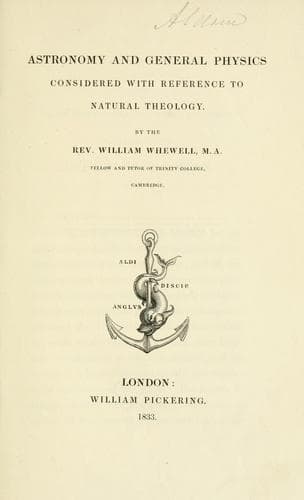
Astronomy and General Physics Considered with Reference to Natural TheologyWhewell, William
Religion
Astronomy and General Physics Considered with Reference to Natural Theology
Whewell, William
Astronomy; Cosmic physics; Natural theology
1. In the first place, the system could not have subsisted, if
the force had followed a _direct_ instead of an inverse law, with
respect to the distance; that is, if it had increased when the
distance increased. It has been sometimes said, that “all direct
laws of force are excluded on account of the danger from perturbing
forces;”[23] that if the planets had pulled at this earth, the
harder the further off they were, they would have dragged it
entirely out of its course. This is not an exact statement of
what would happen: if the force were to be simply in the direct
ratio of the distance, any number of planets might revolve in the
most regular and orderly manner. Their mutual effects, which we
may call perturbations if we please, would be considerable; but
these perturbations would be so combined with the unperturbed
motion, as to produce a new motion not less regular than the
other. This curious result would follow, that every body in the
system would describe, or seem to describe, about every other,
an exact elliptical orbit; and that the times of the revolution
of every body in its orbit would be all equal. This is proved by
Newton, in the sixty-fourth proposition of the Principia. There
would be nothing to prevent all the planets, on this supposition,
from moving round the sun in orbits exactly circular, or nearly
circular, according to the mode in which they were set in motion.
But though the perturbations of the system would not make this
law inadmissible, there are other circumstances which would do so.
Under this law, the gravity of bodies at the earth’s surface would
cease to exist. Nothing would fall or weigh downwards. The greater
action of the distant sun and planets would exactly neutralize the
gravity of the earth: a ball thrown from the hand, however gently,
would immediately become a satellite of the earth, and would for
the future accompany it in its course, revolving about it in the
space of one year. All terrestrial things would float about with no
principle of coherence or stability: they would obey the general
law of the system, but would acknowledge no particular relation
to the earth. We can hardly pretend to judge of the abstract
possibility of such a system of things; but it is clear that it
could not exist without an utter subversion of all that we can
conceive of the economy and structure of the world which we inhabit.
With any other direct law of force, we should in like manner
lose gravity, without gaining the theoretical regularity of
the planetary motions which we have described in the case just
considered.
Public-domain text, read in full here on John Shaqi.
Reviews
Reviews
No reviews yet
Be the first to share your thoughts on this work.
Elsewhere in the archive
Join the Discussion
Join the discussion
Sign in to leave a comment or review.
Sign InorCreate an account