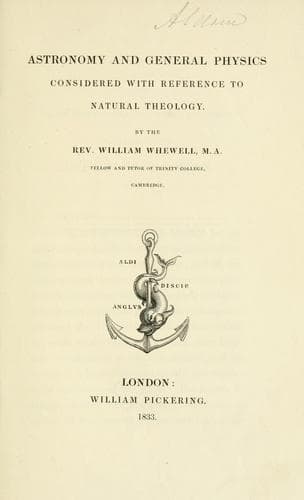
Astronomy and General Physics Considered with Reference to Natural Theology — John Shaqi
Astronomy and General Physics Considered with Reference to Natural TheologyWhewell, William
Religion
Astronomy and General Physics Considered with Reference to Natural Theology
Whewell, William
Astronomy; Cosmic physics; Natural theology
It will be our business to show that the laws which really prevail
in nature are, by their _form_, that is, by the nature of the
connexion which they establish among the quantities and properties
which they regulate, remarkably adapted to the office which is
assigned them; and thus offer evidence of selection, design, and
goodness, in the power by which they were established. But these
characters of the legislation of the universe may also be seen, in
many instances, in a manner somewhat different from the selection
of the law. The _nature of the connexion_ remaining the same, the
quantities which it regulates may also in their _magnitude_ bear
marks of selection and purpose. For the law may be the same while
the quantities to which it applies are different. The law of the
gravity which acts to the earth and to Jupiter, is the same; but
the intensity of the force at the surfaces of the two planets is
different. The law which regulates the density of the air at any
point, with reference to the height from the earth’s surface,
would be the same, if the atmosphere were ten times as large, or
only one-tenth as large as it is; if the barometer at the earth’s
surface stood at three inches only, or if it showed a pressure of
thirty feet of mercury.
Now this being understood, the adaptation of a law to its purpose,
or to other laws, may appear in two ways:--either in the form of
the law, or in the amount of the magnitudes which it regulates,
which are sometimes called _arbitrary magnitudes_.
If the attraction of the sun upon the planets did not vary
inversely as the square of the distance, the _form_ of the law
of gravitation would be changed; if this attraction were, at the
earth’s orbit, of a different _value_ from its present one, the
arbitrary magnitude would be changed; and it will appear, in a
subsequent part of this work, that either change would, so far as
we can trace its consequences, be detrimental. The form of the law
determines in what manner the facts shall take place; the arbitrary
magnitude determines how fast, how far, how soon; the one gives a
model, the other a measure of the phenomenon; the one draws the
plan, the other gives the scale on which it is to be executed; the
one gives the rule, the other the rate. If either were wrongly
taken, the result would be wrong too.
CHAPTER III.
_Mutual Adaptation in the Laws of Nature._
Public-domain text, read in full here on John Shaqi.
Reviews
Reviews
No reviews yet
Be the first to share your thoughts on this work.
Join the Discussion
Join the discussion
Sign in to leave a comment or review.
Sign InorCreate an account