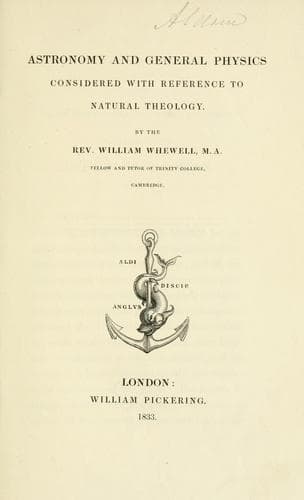
Astronomy and General Physics Considered with Reference to Natural TheologyWhewell, William
Religion
Astronomy and General Physics Considered with Reference to Natural Theology
Whewell, William
Astronomy; Cosmic physics; Natural theology
If we take the whole range of created objects in our own system,
from the sun down to the smallest animalcule, and suppose such a
system, or something in some way analogous to it, to be repeated
for each of the millions of stars thus revealed to us, we have a
representation of the material part of the universe, according to a
view which many minds receive as a probable one; and referring this
aggregate of systems to the Author of the universe, as in our own
system we have found ourselves led to do, we have thus an estimate
of the extent to which his creative energy would thus appear to
have been exercised in the material world.
If we consider further the endless and admirable contrivances and
adaptations which philosophers and observers have discovered in
every portion of our own system, every new step of our knowledge
showing us something new in this respect; and if we combine this
consideration with the thought how small a portion of the universe
our knowledge includes, we shall, without being able at all to
discern the extent of the skill and wisdom thus displayed, see
something of the character of the design, and of the copiousness
and ampleness of the means which the scheme of the world exhibits.
And when we see that the tendency of all the arrangements which
we can comprehend is to support the existence, to develope the
faculties, to promote the well-being of these countless species of
creatures; we shall have some impression of the beneficence and
love of the Creator, as manifested in the physical government of
his creation.
2. It is extremely difficult to devise any means of bringing
before a common apprehension the scale on which the universe is
constructed, the enormous proportion which the larger dimensions
bear to the smaller, and the amazing number of steps from large to
smaller, or from small to larger, which the consideration of it
offers. The following comparative representations may serve to
give the reader to whom the subject is new some idea of these steps.
If we suppose the earth to be represented by a globe a foot in
diameter, the distance of the sun from the earth will be about two
miles; the diameter of the sun, on the same supposition, will be
something above one hundred feet, and consequently his bulk such
as might be made up of two hemispheres, each about the size of the
dome of St. Paul’s. The moon will be thirty feet from us, and her
diameter three inches, about that of a cricket ball. Thus the sun
would much more than occupy all the space within the moon’s orbit.
On the same scale, Jupiter would be above ten miles from the sun,
and Uranus forty. We see then how thinly scattered through space
are the heavenly bodies. The fixed stars would be at an unknown
distance, but, probably, if all distances were thus diminished, no
star would be nearer to such a one-foot earth, than the moon now is
to us.
Public-domain text, read in full here on John Shaqi.
Reviews
Reviews
No reviews yet
Be the first to share your thoughts on this work.
Elsewhere in the archive
Join the Discussion
Join the discussion
Sign in to leave a comment or review.
Sign InorCreate an account