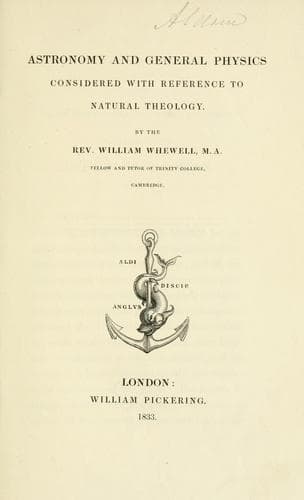
Astronomy and General Physics Considered with Reference to Natural TheologyWhewell, William
Religion
Astronomy and General Physics Considered with Reference to Natural Theology
Whewell, William
Astronomy; Cosmic physics; Natural theology
Some persons might, perhaps, imagine that a ground for believing
the smallness of organized beings to be limited, might be found in
what we know of the constitution of matter. If solids and fluids
consist of particles of a definite, though exceeding smallness,
which cannot further be divided or diminished, it is manifest
that we have, in the smallness of these particles, a limit to the
possible size of the vessels and organs of animals. The fluids
which are secreted, and which circulate in the body of a mite, must
needs consist of a vast number of particles, or they would not be
fluids: and an animal might be so much smaller than a mite, that
its tubes could not contain a sufficient collection of the atoms
of matter, to carry on its functions. We should, therefore, of
necessity reach a limit of minuteness in organic life, if we could
demonstrate that matter is composed of such indivisible atoms. We
shall not, however, build any thing on this argument; because,
though the _atomic theory_ is sometimes said to be proved, what is
proved is, that chemical and other effects take place as if they
were the aggregate of the effects of certain particles of elements,
the _proportions_ of which particles are fixed and definite; but
that any limit can be assigned to the smallness of these particles,
has never yet been made out. We prefer, therefore, to rest the
proof of the finite extent of animal life, as to size, on the
microscopical observations previously referred to.
Probably we cannot yet be said to have reached the limit of the
universe with the power of our telescopes; that is, it does
not appear that telescopes have yet been used, so powerful in
exhibiting small stars, that we can assume that more powerful
instruments would not discover new stars. Whether or no, however,
this degree of perfection has been reached, we have no proof that
it does not exist; if it were once obtained we should have, with
some approximation, the limit of the universe as to the number of
worlds, as we have already endeavoured to show we have obtained
the limits with regard to the largeness and smallness of the
inhabitants of our own world.
In like manner, although the discovery of new species in some of
the kingdoms of nature has gone on recently with enormous rapidity,
and to an immense extent;--for instance in botany, where the
species known in the time of Linnæus were about ten thousand, and
are now probably fifty thousand;--there can be no doubt that the
number of species and genera is really limited; and though a great
extension of our knowledge is required to reach these limits, it
is our ignorance merely, and not their nonexistence, which removes
them from us.
Public-domain text, read in full here on John Shaqi.
Reviews
Reviews
No reviews yet
Be the first to share your thoughts on this work.
Elsewhere in the archive
Join the Discussion
Join the discussion
Sign in to leave a comment or review.
Sign InorCreate an account