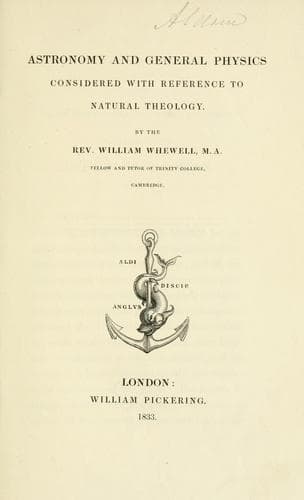
Astronomy and General Physics Considered with Reference to Natural TheologyWhewell, William
Religion
Astronomy and General Physics Considered with Reference to Natural Theology
Whewell, William
Astronomy; Cosmic physics; Natural theology
“Light, and darkness its perpetual contrast; the succession of
days and nights, the periodical order of the seasons; the career
of the brilliant luminary which regulates their course; that of
the moon his sister and rival; night, and the innumerable fires
which she lights in the blue vault of heaven; the revolutions of
the stars, which exhibit them for a longer or a shorter period
above our horizon; the constancy of this period in the fixed stars,
its variety in the wandering stars, the planets; their direct and
retrograde course, their momentary rest; the phases of the moon
waxing, full, waning, divested of all light; the progressive motion
of the sun upwards, downwards; the successive order of the rising
and setting of the fixed stars, which mark the different points of
the course of the sun, while the various aspects which the earth
itself assumes mark, here below also, the same periods of the sun’s
annual motion; * * * all these different pictures, displayed before
the eyes of man, formed the great and magnificent spectacle by
which I suppose him surrounded at the moment when _he is about to
create his gods_.”[31]
What is this (divested of its wanton levity of expression) but to
say, that when man has so far traced the course of nature as to be
irresistibly impressed with the existence of order, law, variety in
constancy, and fixity in change; of relations of form and space,
duration and succession, cause and consequence, among the objects
which surround him; there springs up in his breast, unbidden
and irresistibly, the thought of superintending intelligence,
of a mind which comprehended from the first and completely that
which he late and partially comes to know? The worship of earth
and sky, of the host of heaven and the influences of nature, is
not the ultimate and fundamental fact in the early history of
the religious impressions of mankind. These are but derivative
streams, impure and scanty, from the fountain of religious feeling
which appears to be disclosed to us by the contemplation of the
universe, as the seat of law and the manifestation of intellect.
Time suggests to man the thought of eternity; space of infinity;
law of intelligence; order of purpose; and however difficult and
long a task it may be to develope these suggestions into clear
convictions, these thoughts are the real parents of our natural
religious belief. The only relation between true religion and
the worship of the elemental world is, that the latter is the
partial and gross perversion, the former the consistent and pure
developement of the same original idea.
Public-domain text, read in full here on John Shaqi.
Reviews
Reviews
No reviews yet
Be the first to share your thoughts on this work.
Elsewhere in the archive
Join the Discussion
Join the discussion
Sign in to leave a comment or review.
Sign InorCreate an account