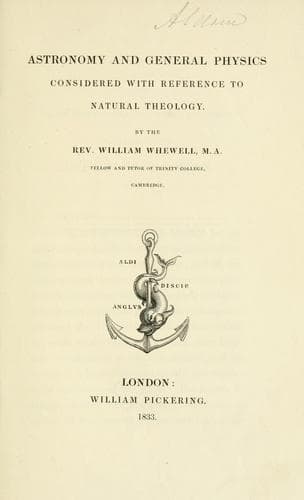
Astronomy and General Physics Considered with Reference to Natural TheologyWhewell, William
Religion
Astronomy and General Physics Considered with Reference to Natural Theology
Whewell, William
Astronomy; Cosmic physics; Natural theology
2. The connexion of the laws of the material world with an
intelligence which preconceived and instituted the law, which
is thus, as we perceive, so generally impressed on the common
apprehension of mankind, has also struck no less those who have
studied nature with a more systematic attention, and with the
peculiar views which belong to science. The laws which such
persons learn and study, seem, indeed, most naturally to lead to
the conviction of an intelligence which originally gave to the law
its form.
What we call a general law is, in truth, a form of expression
including a number of facts of like kind. The facts are separate;
the unity of view by which we associate them, the character of
generality and of law, resides in those relations which are the
object of the intellect. The law once apprehended by us, takes
in our minds the place of the facts themselves, and is said to
_govern_ or determine them, because it determines our anticipations
of what they will be. But we cannot, it would seem, conceive a law,
founded on such intelligible relations, to govern and determine
the facts themselves, any otherwise than by supposing also an
intelligence by which these relations are contemplated, and these
consequences realized. We cannot then represent to ourselves the
universe governed by general laws otherwise than by conceiving an
intelligent and conscious Deity, by whom these laws were originally
contemplated, established, and applied.
This perhaps will appear more clear, when it is considered that
the laws of which we speak are often of an abstruse and complex
kind, depending upon relations of space, time, number, and other
properties, which we perceive by great attention and thought.
These relations are often combined so variously and curiously,
that the most subtle reasonings and calculations which we can form
are requisite in order to trace their results. Can such laws be
conceived to be instituted without any exercise of knowledge and
intelligence? Can material objects apply geometry and calculation
to themselves? Can the lenses of the eye, for instance, be formed
and adjusted with an exact suitableness to their refractive
powers, while there is in the agency which has framed them, no
consciousness of the laws of light, of the course of rays, of
the visible properties of things? This appears to be altogether
inconceivable.
Public-domain text, read in full here on John Shaqi.
Reviews
Reviews
No reviews yet
Be the first to share your thoughts on this work.
Elsewhere in the archive
Join the Discussion
Join the discussion
Sign in to leave a comment or review.
Sign InorCreate an account