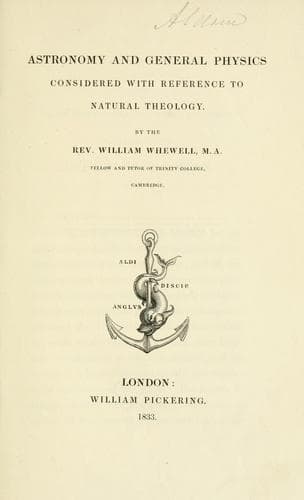
Astronomy and General Physics Considered with Reference to Natural TheologyWhewell, William
Religion
Astronomy and General Physics Considered with Reference to Natural Theology
Whewell, William
Astronomy; Cosmic physics; Natural theology
Every particle of matter possesses an almost endless train of
properties, each acting according to its peculiar and fixed
laws. For every atom of the same kind of matter these laws are
invariably and perpetually the same, while for the different kinds
of matter the difference of these properties is equally constant.
This constant and precise resemblance, this variation equally
constant and equally regular, suggest irresistibly the conception
of some cause, independent of the atoms themselves, by which their
similarity and dissimilarity, the agreement and difference of their
deportment under the same circumstances, have been determined. Such
a view of the constitution of matter, as is observed by an eminent
writer of our own time, effectually destroys the idea of its
eternal and self-existent nature, “by giving to each of its atoms
the essential characters, at once, of a _manufactured article_ and
a _subordinate agent_.”[32]
That such an impression, and the consequent belief in a divine
Author of the universe, by whom its laws were ordained and
established, does result from the philosophical contemplation of
nature, will, we trust, become still more evident by tracing the
effect produced upon men’s minds by the discovery of such laws and
properties as those of which we have been speaking; and we shall
therefore make a few observations on this subject.
CHAPTER V.
_On Inductive Habits; or, on the Impression produced on Men’s Minds
by discovering Laws of Nature._
The object of physical science is to discover such laws and
properties as those of which we have spoken in the last chapter.
In this task, undoubtedly a progress has been made on which we may
well look with pleasure and admiration; yet we cannot hesitate to
confess that the extent of our knowledge on such subjects bears no
proportion to that of our ignorance. Of the great and comprehensive
laws which rule over the widest provinces of natural phenomena, few
have yet been disclosed to us. And the names of the philosophers,
whose high office it has been to detect such laws, are even yet far
from numerous. In looking back at the path by which science has
advanced to its present position, we see the names of the great
discoverers shine out like luminaries, few and scattered along the
line: by far the largest portion of the space is occupied by those
whose comparatively humble office it was to verify, to develope, to
apply the general truths which the discoverers brought to light.
Public-domain text, read in full here on John Shaqi.
Reviews
Reviews
No reviews yet
Be the first to share your thoughts on this work.
Elsewhere in the archive
Join the Discussion
Join the discussion
Sign in to leave a comment or review.
Sign InorCreate an account