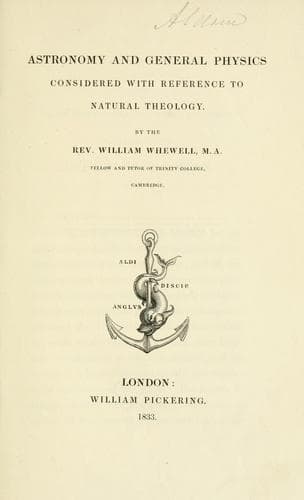
Astronomy and General Physics Considered with Reference to Natural TheologyWhewell, William
Religion
Astronomy and General Physics Considered with Reference to Natural Theology
Whewell, William
Astronomy; Cosmic physics; Natural theology
It will readily be conceived that it is no easy matter, if it be
possible, to analyse the process of thought by which laws of nature
have thus been discovered; a process which, as we have said, has
been in so few instances successfully performed. We shall not here
make any attempt at such an analysis. But without this, we conceive
it may be shown that the constitution and employment of the mind
on which such discoveries depend, are friendly to that belief in
a wise and good Creator and Governor of the world, which it has
been our object to illustrate and confirm. And if it should appear
that those who see further than their fellows into the bearings
and dependencies of the material things and elements by which they
are surrounded, have also been, in almost every case, earnest and
forward in acknowledging the relation of all things to a supreme
intelligence and will; we shall be fortified in our persuasion
that the true scientific perception of the general constitution
of the universe, and of the mode in which events are produced and
connected, is fitted to lead us to the conception and belief of God.
Let us consider for a moment what takes place in the mind of a
student of nature when he attains to the perception of a law
previously unknown, connecting the appearances which he has
studied. A mass of facts which before seemed incoherent and
unmeaning, assume, on a sudden, the aspect of connexion and
intelligible order. Thus, when Kepler discovered the law which
connects the periodic times with the diameters of the planetary
orbits; or, when Newton showed how this and all other known
mathematical properties of the solar system were included in the
law of universal gravitation according to the inverse square of
the distance; particular circumstances which, before, were merely
matter of independent record, became, from that time, indissolubly
conjoined by the laws so discovered. The separate occurrences and
facts, which might hitherto have seemed casual and without reason,
were now seen to be all exemplifications of the same truth. The
change is like that which takes place when we attempt to read a
sentence written in difficult or imperfect characters. For a time
the separate parts appear to be disjointed and arbitrary marks; the
suggestions of possible meanings, which succeed each other in the
mind, fail, as fast as they are tried, in combining or accounting
for these symbols: but at last the true supposition occurs; some
words are found to coincide with the meaning thus assumed; the
whole line of letters appear to take definite shapes and to leap
into their proper places; and the truth of the happy conjecture
seems to flash upon us from every part of the inscription.
Public-domain text, read in full here on John Shaqi.
Reviews
Reviews
No reviews yet
Be the first to share your thoughts on this work.
Elsewhere in the archive
Join the Discussion
Join the discussion
Sign in to leave a comment or review.
Sign InorCreate an account