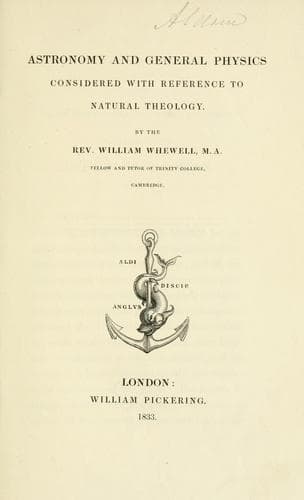
Astronomy and General Physics Considered with Reference to Natural TheologyWhewell, William
Religion
Astronomy and General Physics Considered with Reference to Natural Theology
Whewell, William
Astronomy; Cosmic physics; Natural theology
The discovery of laws of nature, truly and satisfactorily
connecting and explaining phenomena, of which, before, the
connexion and causes had been unknown, displays much of a similar
process, of obscurity succeeded by evidence, of effort and
perplexity followed by conviction and repose. The innumerable
conjectures and failures, the glimpses of light perpetually
opening and as often clouded over, the unwearied perseverance and
inexhaustible ingenuity exercised by Kepler in seeking for the
laws which he finally discovered, are, thanks to his communicative
disposition, curiously exhibited in his works, and have been
narrated by his biographers; and such efforts and alternations,
modified by character and circumstances, must generally precede
the detection of any of the wider laws and dependencies by which
the events of the universe are regulated. We may readily conceive
the satisfaction and delight with which, after this perplexity and
struggle, the discoverer finds himself in light and tranquillity;
able to look at the province of nature which has been the subject
of his study, and to read there an intelligible connexion, a
sufficing reason, which no one before him had understood or
apprehended.
This step so much resembles the mode in which one intelligent being
understands and apprehends the conceptions of another, that we
cannot be surprised if those persons in whose minds such a process
has taken place, have been most ready to acknowledge the existence
and operation of a superintending intelligence, whose ordinances it
was their employment to study. When they had just read a sentence
of the table of the laws of the universe, they could not doubt
whether it had had a legislator. When they had deciphered there a
comprehensive and substantial truth, they could not believe that
the letters had been thrown together by chance. They could not but
readily acknowledge that what their faculties had enabled them to
read, must have been written by some higher and profounder mind.
And accordingly, we conceive it will be found, on examining the
works of those to whom we owe our knowledge of the laws of nature,
and especially of the wider and more comprehensive laws, that
such persons have been strongly and habitually impressed with the
persuasion of a Divine Purpose and Power which had regulated the
events which they had attended to, and ordained the laws which they
had detected.
Public-domain text, read in full here on John Shaqi.
Reviews
Reviews
No reviews yet
Be the first to share your thoughts on this work.
Elsewhere in the archive
Join the Discussion
Join the discussion
Sign in to leave a comment or review.
Sign InorCreate an account