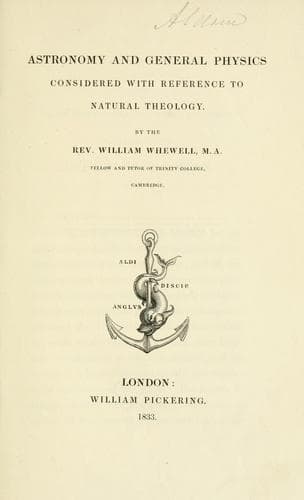
Astronomy and General Physics Considered with Reference to Natural TheologyWhewell, William
Religion
Astronomy and General Physics Considered with Reference to Natural Theology
Whewell, William
Astronomy; Cosmic physics; Natural theology
To those who have pursued science without reaching the rank of
discoverers;--who have possessed a derivative knowledge of the laws
of nature which others had disclosed, and have employed themselves
in tracing the consequences of such laws, and systematizing the
body of truth thus produced, the above description does not apply;
and we have not therefore in these cases the same ground for
anticipating the same frame of mind. If among men of science of
this class, the persuasion of a supreme Intelligence has at some
periods been less vivid and less universal, than in that higher
class of which we have before spoken, the fact, so far as it has
existed, may perhaps be in some degree accounted for. But whether
the view which we have to give of the mental peculiarities of men
whose science is of this derivative kind be well founded, and
whether the account we have above offered of that which takes
place in the minds of original discoverers of laws in scientific
researches be true, or not, it will probably be considered a matter
of some interest to point out historically that in fact, such
discoverers have been peculiarly in the habit of considering the
world as the work of God. This we shall now proceed to do.
As we have already said, the names of _great_ discoverers are
not very numerous. The sciences which we may look upon as having
reached or at least approached their complete and finished form,
are Mechanics, Hydrostatics, and Physical Astronomy. Galileo is
the father of modern Mechanics; Copernicus, Kepler, and Newton are
the great names which mark the progress of Astronomy. Hydrostatics
shared in a great measure the fortunes of the related science of
Mechanics; Boyle and Pascal were the persons mainly active in
developing its more peculiar principles. The other branches of
knowledge which belong to natural philosophy, as Chemistry and
Meteorology, are as yet imperfect, and perhaps infant sciences;
and it would be rash to presume to select, in them, names of equal
preeminence with those above mentioned: but it may not be difficult
to show, with sufficient evidence, that the effect of science upon
the authors of science is, in these subjects as in the former ones,
far other than to alienate their minds from religious trains of
thought, and a habit of considering the world as the work of God.
Public-domain text, read in full here on John Shaqi.
Reviews
Reviews
No reviews yet
Be the first to share your thoughts on this work.
Elsewhere in the archive
Join the Discussion
Join the discussion
Sign in to leave a comment or review.
Sign InorCreate an account