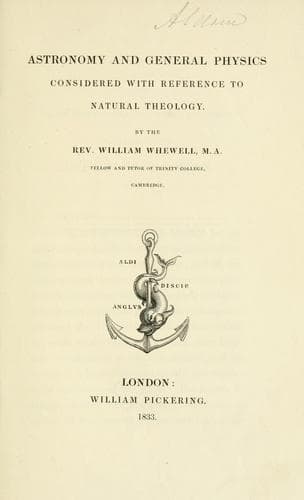
Astronomy and General Physics Considered with Reference to Natural TheologyWhewell, William
Religion
Astronomy and General Physics Considered with Reference to Natural Theology
Whewell, William
Astronomy; Cosmic physics; Natural theology
The next great step in our knowledge of the universe, the discovery
of the mechanical causes by which its motions are produced, and
of their laws, has in modern times sometimes been supposed, both
by the friends of religion and by others, to be unfavourable
to the impression of an intelligent first cause. That such a
supposition is founded in error we have offered what appear to us
insurmountable reasons for believing. That in the mind of the great
discoverer of this mechanical cause, Newton, the impression of a
creating and presiding Deity was confirmed, not shaken, by all
his discoveries, is so well known that it is almost superfluous
to insist upon the fact. His views of the tendency of science
invested it with no dangers of this kind. “The business of
natural philosophy is,” he says, (Optics, Qu. 28,) “to argue from
phenomena without feigning hypotheses, and to deduce cause from
effects, till we come to the very first cause, which is certainly
not mechanical.” “Though every true step made in this philosophy
brings us not immediately to the knowledge of the first cause, yet
it brings us nearer to it, and is on that account highly to be
valued.” The Scholium, or note, which concludes his great work,
the Principia, is a well known and most striking evidence on this
point, “This beautiful system of sun, planets, and comets, could
have its origin in no other way than by the purpose and command of
an intelligent and powerful Being. He governs all things, not as
the soul of the world, but as the lord of the universe. He is not
only God, but Lord or Governor. We know him only by his properties
and attributes, by the wise and admirable structure of things
around us, and by their final causes; we admire him on account of
his perfections, we venerate and worship him on account of his
government.”
Without making any further quotations, it must be evident to
the reader that the succession of great philosophers through
whom mankind have been led to the knowledge of the greatest of
scientific truths, the law of universal gravitation, did, for
their parts, see the truths which they disclosed to men in such a
light that their religious feelings, their reference of the world
to an intelligent Creator and Preserver, their admiration of his
attributes, were exalted rather than impaired by the insight which
they obtained into the structure of the universe.
Having shown this with regard to the most perfect portion of human
knowledge, our knowledge of the motions of the solar system, we
shall adduce a few other passages, illustrating the prevalence
of the same fact in other departments of experimental science;
although, for reasons which have already been intimated, we
conceive that sciences of experiment do not conduct so obviously as
sciences of observation to the impression of a Divine Legislator of
the material world.
Public-domain text, read in full here on John Shaqi.
Reviews
Reviews
No reviews yet
Be the first to share your thoughts on this work.
Elsewhere in the archive
Join the Discussion
Join the discussion
Sign in to leave a comment or review.
Sign InorCreate an account