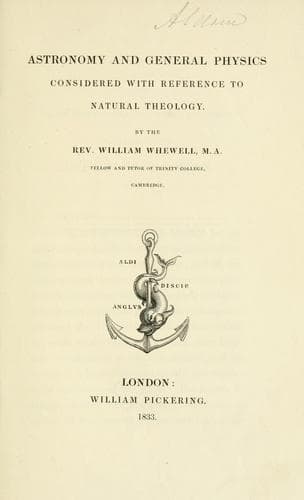
Astronomy and General Physics Considered with Reference to Natural TheologyWhewell, William
Religion
Astronomy and General Physics Considered with Reference to Natural Theology
Whewell, William
Astronomy; Cosmic physics; Natural theology
The science of Hydrostatics was constructed in a great measure by
the founders of the sister science of Mechanics. Of those who were
employed in experimentally establishing the principles peculiarly
belonging to the doctrine of fluids, Pascal and Boyle are two of
the most eminent names. That these two great philosophers were
not only religious, but both of them remarkable for their fervent
and pervading devotion, is too well known to be dwelt on. With
regard to Pascal, however, we ought not perhaps to pass over an
opinion of his, that the existence of God cannot be proved from the
external world. “I do not undertake to prove this,” says he, “not
only because I do not feel myself sufficiently strong to find in
nature that which shall convince obstinate atheists, but because
such knowledge without Jesus Christ is useless and steril.” It is
obvious that such a state of mind would prevent this writer from
encouraging or dwelling upon the grounds of natural religion; while
yet he himself is an example of that which we wish to illustrate,
that those who have obtained the furthest insight into nature,
have been in all ages firm believers in God. “Nature,” he says, in
another place, “has perfections in order to show that she is the
image of God, and defects in order to show that she is only his
image.”[35]
Boyle was not only a most pious man as well as a great philosopher,
but he exerted himself very often and earnestly in his writings
to show the bearing of his natural philosophy upon his views of
the Divine attributes, and of the government of the world. Many
of these dissertations convey trains of thought and reasoning
which have never been surpassed for their combination of judicious
sobriety in not pressing his arguments too far, with fervent
devotion in his conceptions of the Divine nature. As examples of
these merits, we might adduce almost any portion of his tracts on
these subjects; for instance, his “Inquiry into the Final Causes
of Natural Things;” his “Free Inquiry into the Vulgar Notion of
Nature;” his “Christian Virtuoso;” and his essay entitled “The High
Veneration Man’s Intellect owes to God.” It would be superfluous to
quote at any length from these works. We may observe, however, that
he notices that general fact which we are at present employed in
exemplifying, that “in almost all ages and countries the generality
of philosophers and contemplative men were persuaded of the
existence of a Deity from the consideration of the phenomena of the
universe; whose fabric and conduct they rationally concluded could
not justly be ascribed either to chance or to any other cause than
a Divine Being.” And in speaking of the religious uses of science,
he says: “Though I am willing to grant that some impressions of
God’s wisdom are so conspicuous that even a superficial philosopher
may thence infer that the author of such works must be a wise
agent; yet how wise an agent he has in these works expressed
Public-domain text, read in full here on John Shaqi.
Reviews
Reviews
No reviews yet
Be the first to share your thoughts on this work.
Elsewhere in the archive
Join the Discussion
Join the discussion
Sign in to leave a comment or review.
Sign InorCreate an account