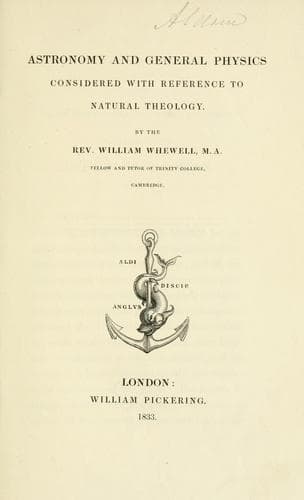
Astronomy and General Physics Considered with Reference to Natural TheologyWhewell, William
Religion
Astronomy and General Physics Considered with Reference to Natural Theology
Whewell, William
Astronomy; Cosmic physics; Natural theology
himself to be, none but an experimental philosopher can well
discern. And ’tis not by a slight survey, but by a diligent and
skilful scrutiny, of the works of God, that a man must be, by a
rational and affective conviction, engaged to acknowledge that
the author of nature ‘is wonderful in counsel, and excellent in
working.’”
After the mechanical properties of fluids, the laws of the
operation of the chemical and physical properties of the elements
about us, offer themselves to our notice. The relations of heat
and of moisture in particular, which play so important a part, as
we have seen, in the economy of our world, have been the subject
of various researches; and they have led to views of the operation
of such agents, some of which we have endeavoured to present to
the reader, and to point out the remarkable arrangements by which
their beneficial operation is carried on. That the discoverers
of the laws by which such operations are regulated, were not
insensible to the persuasion of a Divine care and contrivance
which those arrangements suggest, is what we should expect, in
agreement with what we have already said, and it is what we find.
Among the names of the philosophers to whom we owe our knowledge
on these subjects, there are none greater than those of Black,
the discoverer of the laws of latent heat, and Dalton, who first
gave us a true view of the mode in which watery vapour exists and
operates in the atmosphere. With regard to the former of these
philosophers, we shall quote Dr. Thomson’s account of the views
which the laws of latent heat suggested to the discoverer.[36] “Dr.
Black quickly perceived the vast importance of this discovery,
and took a pleasure in laying before his students a view of
the beneficial effects of this habitude of heat in the economy
of nature. During the summer season a vast magazine of heat is
accumulated in the water, which by gradually emerging during
congelation serves to temper the cold of winter. Were it not for
this accumulation of heat in water and other bodies, the sun would
no sooner go a few degrees to the south of the equator than we
should feel all the horrors of winter.”
In the same spirit are Mr. Dalton’s reflections, after pointing
out the laws which regulate the balance of evaporation and
rain,[37] which he himself first clearly explained. “It is scarcely
possible,” says he, “to contemplate without admiration the
beautiful system of nature by which the surface of the earth is
continually supplied with water, and that unceasing circulation of
a fluid so essentially necessary to the very being of the animal
and vegetable kingdom takes place.”
Public-domain text, read in full here on John Shaqi.
Reviews
Reviews
No reviews yet
Be the first to share your thoughts on this work.
Elsewhere in the archive
Join the Discussion
Join the discussion
Sign in to leave a comment or review.
Sign InorCreate an account