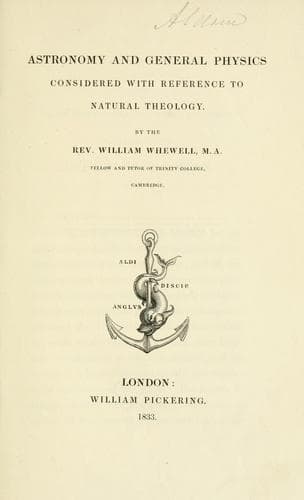
Astronomy and General Physics Considered with Reference to Natural TheologyWhewell, William
Religion
Astronomy and General Physics Considered with Reference to Natural Theology
Whewell, William
Astronomy; Cosmic physics; Natural theology
Such impressions appear thus to rise irresistibly in the breasts
of men, when they obtain a sight, for the first time, of the
varied play and comprehensive connexions of the laws by which the
business of the material world is carried on and its occurrences
brought to pass. To dwell upon or develope such reflections is not
here our business. Their general prevalence in the minds of those
to whom these first views of new truths are granted, has been, we
trust, sufficiently illustrated. Nor are the names adduced above,
distinguished as they are, brought forwards as _authorities_
merely. We do not claim for the greatest discoverers in the realms
of science any immunity from error. In their general opinions they
may, as others may, judge or reason ill. The articles of their
religious belief may be as easily and as widely as of other men’s,
imperfect, perverted, unprofitable. But on this one point, the
tendency of our advances in scientific knowledge of the universe
to lead us up to a belief in a most wise maker and master of the
universe, we conceive that they who make these advances, and who
feel, as an original impression, that which others feel only
by receiving their teaching, must be looked to with a peculiar
attention and respect. And what their impressions have commonly
been, we have thus endeavoured to show.
CHAPTER VI.
_On Deductive Habits; or, on the Impression produced on Men’s
Minds by tracing the consequences of ascertained Laws._
The opinion illustrated in the last chapter, that the advances
which men make in science tend to impress upon them the reality of
the Divine government of the world, has often been controverted.
Complaints have been made, and especially of late years, that the
growth of piety has not always been commensurate with the growth
of knowledge, in the minds of those who make nature their study.
Views of an irreligious character have been entertained, it is
sometimes said, by persons eminently well instructed in all the
discoveries of modern times, no less than by the superficial and
ignorant. Those who have been supposed to deny or to doubt the
existence, the providence, the attributes of God, have in many
cases been men of considerable eminence and celebrity for their
attainments in science. The opinion that this is the case, appears
to be extensively diffused, and this persuasion has probably
often produced inquietude and grief in the breasts of pious and
benevolent men.
Public-domain text, read in full here on John Shaqi.
Reviews
Reviews
No reviews yet
Be the first to share your thoughts on this work.
Elsewhere in the archive
Join the Discussion
Join the discussion
Sign in to leave a comment or review.
Sign InorCreate an account