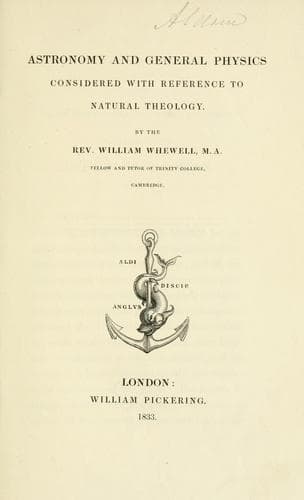
Astronomy and General Physics Considered with Reference to Natural TheologyWhewell, William
Religion
Astronomy and General Physics Considered with Reference to Natural Theology
Whewell, William
Astronomy; Cosmic physics; Natural theology
This opinion, concerning the want of religious convictions among
those who have made natural philosophy their leading pursuit,
has probably gone far beyond the limits of the real fact. But if
we allow that there are any strong cases to countenance such an
opinion, it may be worth our while to consider how far they admit
of any satisfactory explanation. The fact appears at first sight
to be at variance with the view we have given of the impression
produced by scientific discovery; and it is moreover always a
matter of uneasiness and regret, to have men of eminent talents
and knowledge opposed to doctrines which we consider as important
truths.
We conceive that an explanation of such cases, if they should
occur, may be found in a very curious and important circumstance
belonging to the process by which our physical sciences are formed.
The first discovery of new general truths, and the developement
of these truths when once obtained, are two operations extremely
different; imply different mental habits, and may easily be
associated with different views and convictions on points out of
the reach of scientific demonstration. There would therefore be
nothing surprising, or inconsistent with what we have maintained
above, if it should appear that while original discoverers of laws
of nature are peculiarly led, as we have seen, to believe the
existence of a supreme intelligence and purpose; the far greater
number of cultivators of science, whose employment it is to learn
from others these general laws, and to trace, combine, and apply
their consequences, should have no clearness of conviction or
security from error on this subject, beyond what belongs to persons
of any other class.
This will, perhaps, become somewhat more evident by considering
a little more closely the distinction of the two operations of
discovery and developement, of which we have spoken above, and the
tendency which the habitual prosecution of them may be expected to
produce in the thoughts and views of the student.
We have already endeavoured in some measure to describe that which
takes place when a new law of nature is discovered. A number of
facts in which, before, order and connexion did not appear at all,
or appeared by partial and contradictory glimpses, are brought
into a point of view in which order and connexion become their
essential character. It is seen that each fact is but a different
manifestation of the same principle; that each particular is that
which it is, in virtue of the same general truth. The inscription
is deciphered; the enigma is guessed; the principle is understood;
the truth is enunciated.
Public-domain text, read in full here on John Shaqi.
Reviews
Reviews
No reviews yet
Be the first to share your thoughts on this work.
Elsewhere in the archive
Join the Discussion
Join the discussion
Sign in to leave a comment or review.
Sign InorCreate an account