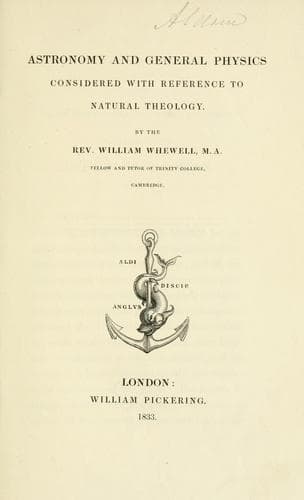
Astronomy and General Physics Considered with Reference to Natural TheologyWhewell, William
Religion
Astronomy and General Physics Considered with Reference to Natural Theology
Whewell, William
Astronomy; Cosmic physics; Natural theology
When this step is once made, it becomes possible to deduce from the
truth thus established, a train of consequences often in no small
degree long and complex. The process of making these inferences
may properly be described by the word Deduction, while the very
different process by which a new principle is collected from an
assemblage of facts, has been termed Induction; the truths so
obtained and their consequences constitute the results of the
Inductive Philosophy; which is frequently and rightly described
as a science which ascends from particular facts to general
principles, and then descends again from these general principles
to particular applications and exemplifications.
While the great and important labours by which science is really
advanced consist in the successive steps of the _inductive_ ascent
in the discovery of new laws perpetually more and more general; by
far the greater part of our books of physical science unavoidably
consists in _deductive_ reasoning, exhibiting the consequences
and applications of the laws which have been discovered; and the
greater part of writers upon science have their minds employed in
this process of deduction and application.
This is true of many of those who are considered, and justly,
as distinguished and profound philosophers. In the mechanical
philosophy, that science which applies the properties of matter
and the laws of motion to the explanation of the phenomena of
the world, this is peculiarly the case. The laws, when once
discovered, occupy little room in their statement, and when no
longer contested, are not felt to need a lengthened proof. But
their consequences require far more room and far more intellectual
labour. If we take, for example, the laws of motion and the law
of universal gravitation, we can express in a few lines, that
which, when developed, represents and explains an innumerable
mass of natural phenomena. But here the course of developement is
necessarily so long, the reasoning contains so many steps, the
considerations on which it rests are so minute and refined, the
complication of cases and of consequences is so vast, and even
the involution arising from the properties of space and number
so serious, that the most consummate subtlety, the most active
invention, the most tenacious power of inference, the widest spirit
of combination, must be tasked and tasked severely, in order to
solve the problems which belong to this portion of science. And
the persons who have been employed on these problems, and who
have brought to them the high and admirable qualities which such
an office requires, have justly excited in a very eminent degree
the admiration which mankind feel for great intellectual powers.
Their names occupy a distinguished place in literary history; and
probably there are no scientific reputations of the last century
higher, and none more merited, than those earned by the great
mathematicians who have laboured with such wonderful success in
Public-domain text, read in full here on John Shaqi.
Reviews
Reviews
No reviews yet
Be the first to share your thoughts on this work.
Elsewhere in the archive
Join the Discussion
Join the discussion
Sign in to leave a comment or review.
Sign InorCreate an account