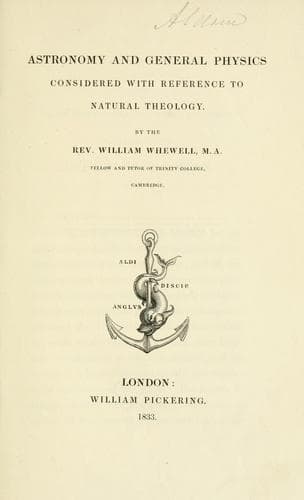
Astronomy and General Physics Considered with Reference to Natural TheologyWhewell, William
Religion
Astronomy and General Physics Considered with Reference to Natural Theology
Whewell, William
Astronomy; Cosmic physics; Natural theology
unfolding the mechanism of the heavens; such for instance as
D’Alembert, Clairault, Euler, Lagrange, Laplace.
But it is still important to recollect, that the mental employments
of men, while they are occupied in this portion of the task of the
formation of science, are altogether different from that which
takes place in the mind of a discoverer, who, for the first time,
seizes the principle which connects phenomena before unexplained,
and thus adds another original truth to our knowledge of the
universe. In explaining, as the great mathematicians just mentioned
have done, the phenomena of the solar system by means of the law
of universal gravitation, the conclusions at which they arrived
were really included in the truth of the law itself, whatever skill
and sagacity it might require to develope and extricate them from
the general principle. But when Newton conceived and established
the law itself, he added to our knowledge something which was not
contained in any truth previously known, nor deducible from it by
any course of mere reasoning. And the same distinction, in all
other cases, obtains, between these processes which establish the
principles, generally few and simple, on which our sciences rest,
and those reasonings and calculations, founded on the principles
thus obtained, which constitute by far the larger portion of
the common treatises on the most complete of the sciences now
cultivated.
Since the difference is so great between the process of inductive
generalization of physical facts, and that of mathematical
deduction of consequences, it is not surprising that the two
processes should imply different mental powers and habits. However
rare the mathematical talent, in its highest excellence, may be,
it is far more common, if we are to judge from the history of
science, than the genius which divines the general laws of nature.
We have several good mathematicians in every age; we have few great
discoverers in the whole history of our species.
The distinction being thus clearly established between original
discovery and derivative speculation, between the ascent to
principles and the descent from them, we have further to observe,
that the habitual and exclusive prosecution of the latter process
may sometimes exercise an unfavourable effect on the mind of the
student, and may make him less fitted and ready to apprehend and
accept truths different from those with which his reasonings
are concerned. We conceive, for example, that a person labours
under gross error, who believes the phenomena of the world to be
altogether produced by mechanical causes, and who excludes from
his view all reference to an intelligent First Cause and Governor.
But we conceive that reasons may be shown which make it more
probable that error of such a kind should find a place in the mind
of a person of deductive, than of inductive habits;--of a mere
mathematician or logician, than of one who studies the facts of the
natural world and detects their laws.
Public-domain text, read in full here on John Shaqi.
Reviews
Reviews
No reviews yet
Be the first to share your thoughts on this work.
Elsewhere in the archive
Join the Discussion
Join the discussion
Sign in to leave a comment or review.
Sign InorCreate an account