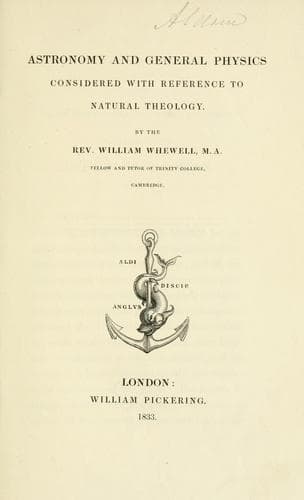
Astronomy and General Physics Considered with Reference to Natural TheologyWhewell, William
Religion
Astronomy and General Physics Considered with Reference to Natural Theology
Whewell, William
Astronomy; Cosmic physics; Natural theology
The person whose mind is employed in reducing to law and order and
intelligible cause the complex facts of the material world, is
compelled to look beyond the present state of his knowledge, and
to turn his thoughts to the existence of principles higher than
those which he yet possesses. He has seen occasions when facts
that at first seemed incoherent and anomalous, were reduced to
rule and connexion; and when limited rules were discovered to be
included in some rule of superior generality. He knows that all
facts and appearances, all partial laws, however confused and
casual they at present seem, must still, in reality, have this
same kind of bearing and dependence;--must be bound together by
some undiscovered principle of order;--must proceed from some
cause working by most steady rules;--must be included in some
wide and fruitful general truth. He cannot therefore consider any
principles which he has already obtained, as the ultimate and
sufficient reason of that which he sees. There must be some higher
principle, some ulterior reason. The effort and struggle by which
he endeavours to extend his view, makes him feel that there is a
region of truth not included in his present physical knowledge; the
very imperfection of the light in which he works his way, suggests
to him that there must be a source of clearer illumination at a
distance from him.
We must allow that it is scarcely possible to describe in a manner
free from some vagueness and obscurity, the effect thus produced
upon the mind by the efforts which it makes to reduce natural
phenomena to general laws. But we trust it will still be allowed
that there is no difficulty in seeing clearly that a different
influence may result from this process, and from the process
of deductive reasoning which forms the main employment of the
mathematical cultivators and systematic expositors of physical
science in modern times. Such persons are not led by their pursuits
to any thing beyond the general principles, which form the basis
of their explanations and applications. They acquiesce in these;
they make these their ultimate grounds of truth; and they are
entirely employed in unfolding the particular truths which are
involved in the general truth. Their thoughts dwell little upon the
possibility of the laws of nature being other than we find them
to be, or on the reasons why they are not so; and still less on
those facts and phenomena which philosophers have not yet reduced
to any rule; which are lawless to us, though we know that, in
reality, they are governed by some principle of order and harmony.
On the contrary, by assuming perpetually the existing laws as
the basis of their reasoning, without question or doubt, and by
employing such language that these laws can be expressed in the
simplest and briefest form, they are led to think and believe as
if these laws were necessarily and inevitably what they are. Some
mathematicians indeed have maintained that the highest laws of
Public-domain text, read in full here on John Shaqi.
Reviews
Reviews
No reviews yet
Be the first to share your thoughts on this work.
Elsewhere in the archive
Join the Discussion
Join the discussion
Sign in to leave a comment or review.
Sign InorCreate an account