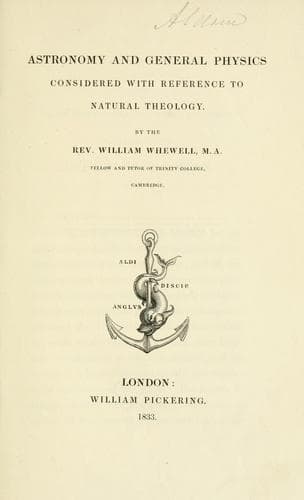
Astronomy and General Physics Considered with Reference to Natural TheologyWhewell, William
Religion
Astronomy and General Physics Considered with Reference to Natural Theology
Whewell, William
Astronomy; Cosmic physics; Natural theology
nature with which we are acquainted, the laws of motion and the
law of universal gravitation, are not only necessarily true, but
are even self-evident and certain _à priori_, like the truths of
geometry. And though the mathematical cultivator of the science of
mechanics may not adopt this as his speculative opinion, he may
still be so far influenced by the tendency from which it springs,
as to rest in the mechanical laws of the universe as ultimate and
all-sufficient principles, without seeing in them any evidence of
their having been selected and ordained, and thus without ascending
from the world to the thought of an Intelligent Ruler. He may thus
substitute for the Deity certain axioms and first principles, as
the cause of all. And the follower of Newton may run into the error
with which he is sometimes charged, of thrusting some mechanic
cause into the place of God, if he do not raise his views, as his
master did, to some higher cause, to some source of all forces,
laws, and principles.
When, therefore, we consider the mathematicians who are employed
in successfully applying the mechanical philosophy, as men well
deserving of honour from those who take an interest in the progress
of science, we do rightly; but it is still to be recollected, that
in doing this they are not carrying us to any higher point of view
in the knowledge of nature than we had attained before: they are
only unfolding the consequences, which were already virtually in
our possession, because they were implied in principles already
discovered:--they are adding to our knowledge of effects, but
not to our knowledge of causes:--they are not making any advance
in that progress of which Newton spoke, and in which he made so
vast a stride, in which “every step made brings us nearer to the
knowledge of the first cause, and is on that account highly to be
valued.” And as in this advance they have no peculiar privileges or
advantages, their errors of opinion concerning it, if they err, are
no more to be wondered at, than those of common men; and need as
little disturb or distress us, as if those who committed them had
confined themselves to the study of arithmetic or of geometry. If
we can console and tranquillize ourselves concerning the defective
or perverted views of religious truth entertained by any of our
fellow men, we need find no additional difficulty in doing so when
those who are mistaken are great mathematicians, who have added to
the riches and elegance of the mechanical philosophy. And if we
are seeking for extraneous grounds of trust and comfort on this
subject, we may find them in the reflection;--that, whatever may
be the opinions of those who assume the causes and laws of that
philosophy and reason from them, the views of those admirable and
ever-honoured men who first caught sight of these laws and causes,
impressed _them_ with the belief that this is “the fabric of a
great and good God;” that “it is man’s duty to pour out his soul in
Public-domain text, read in full here on John Shaqi.
Reviews
Reviews
No reviews yet
Be the first to share your thoughts on this work.
Elsewhere in the archive
Join the Discussion
Join the discussion
Sign in to leave a comment or review.
Sign InorCreate an account