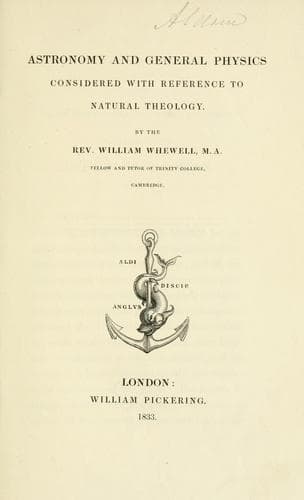
Astronomy and General Physics Considered with Reference to Natural TheologyWhewell, William
Religion
Astronomy and General Physics Considered with Reference to Natural Theology
Whewell, William
Astronomy; Cosmic physics; Natural theology
praise of the Creator;” and that all this beautiful system must be
referred to “a first cause, which is certainly not mechanical.”
2. We may thus, with the greatest propriety, deny to the mechanical
philosophers and mathematicians of recent times any authority
with regard to their views of the administration of the universe;
we have no reason whatever to expect from their speculations any
help, when we attempt to ascend to the first cause and supreme
ruler of the universe. But we might perhaps go further, and assert
that they are in some respects less likely than men employed in
other pursuits, to make any clear advance towards such a subject
of speculation. Persons whose thoughts are thus entirely occupied
in deduction are apt to forget that this is, after all, only one
employment of the reason among more; only one mode of arriving
at truth, needing to have its deficiencies completed by another.
Deductive reasoners, those who cultivate science, of whatever
kind, by means of mathematical and logical processes alone, may
acquire an exaggerated feeling of the amount and value of their
labours. Such employments, from the clearness of the notions
involved in them, the irresistible concatenation of truths which
they unfold, the subtlety which they require, and their entire
success in that which they attempt, possess a peculiar fascination
for the intellect. Those who pursue such studies have generally
a contempt and impatience of the pretensions of all those other
portions of our knowledge, where from the nature of the case, or
the small progress hitherto made in their cultivation, a more
vague and loose kind of reasoning seems to be adopted. Now if this
feeling be carried so far as to make the reasoner suppose that
these mathematical and logical processes can lead him to all the
knowledge and all the certainty which we need, it is clearly a
delusive feeling. For it is confessed on all hands, that all which
mathematics or which logic can do, is to develope and extract
those truths, as conclusions, which were in reality involved in
the principles on which our reasonings proceeded.[38] And this
being allowed, we cannot but ask how we obtain these principles?
from what other source of knowledge we derive the original truths
which we thus pursue into detail? since it is manifest that such
principles cannot be derived from the proper stores of mathematics
or logic. These methods can generate no new truth; and all the
grounds and elements of the knowledge which, through them, we
can acquire, must necessarily come from some extraneous source.
It is certain, therefore, that the mathematician and the logician
must derive from some process different from their own, the
substance and material of all our knowledge, whether physical or
metaphysical, physiological or moral. This process, by which we
acquire our first principles, (without pretending here to analyse
it,) is obviously the general course of human experience, and the
Public-domain text, read in full here on John Shaqi.
Reviews
Reviews
No reviews yet
Be the first to share your thoughts on this work.
Elsewhere in the archive
Join the Discussion
Join the discussion
Sign in to leave a comment or review.
Sign InorCreate an account