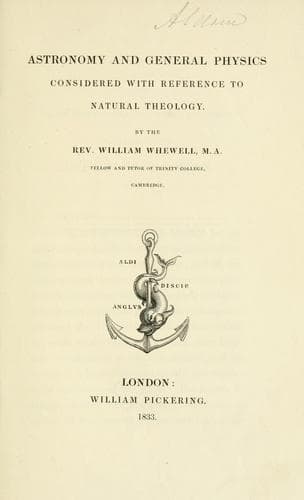
Astronomy and General Physics Considered with Reference to Natural TheologyWhewell, William
Religion
Astronomy and General Physics Considered with Reference to Natural Theology
Whewell, William
Astronomy; Cosmic physics; Natural theology
This is so obvious, that charges are frequently brought against
the study of mathematics, as unfitting men for those occupations
which depend upon our common instinctive convictions and feelings,
upon the unsystematic exercise of the understanding with regard
to common relations and common occurrences. Bonaparte observed of
Laplace, when he was placed in a public office of considerable
importance, that he did not discharge it in so judicious and
clear sighted a manner as his high intellectual fame might lead
most persons to expect.[39] “He sought,” that great judge of
character said, “subtleties in every subject, and carried into
his official employments the spirit of the method of infinitely
small quantities,” by which the mathematician solves his more
abstruse problems. And the complaint that mathematical studies
make men insensible to moral evidence and to poetical beauties, is
so often repeated as to show that some opposition of tendency is
commonly perceived between that exercise of the intellect which
mathematics requires and those processes which go on in our minds
when moral character or imaginative beauty is the subject of our
contemplation.
Thus, while we acknowledge all the beauty and all the value of
the mathematical reasonings by which the consequences of our
general laws are deduced, we may yet consider it possible that
a philosopher, whose mind has been mainly employed, and his
intellectual habits determined, by this process of deduction, may
possess, in a feeble and imperfect degree only, some of those
faculties by which truth is attained, and especially those truths
which regard our relation to that mind, the origin of all law, the
source of first principles, which must be immeasurably elevated
above all derivative truths. It would, therefore, be far from
surprising, if there should be found, among the great authors
of the developements of the mechanical philosophy, some who had
refused to refer the phenomena of the universe to a supreme mind,
purpose, and will. And though this world be, to a believer in the
Being and government of God, a matter of sorrow and pain, it need
not excite more surprise than if the same were true of a person
of the most ordinary endowments, when it is recollected in what a
disproportionate manner the various faculties of such a philosopher
may have been cultivated. And our apprehensions of injury to
mankind from the influence of such examples will diminish, when
we consider, that those mathematicians whose minds have been less
partially exercised, the great discoverers of the truths which
others apply, the philosophers who have looked upwards as well as
downwards, to the unknown as well as to the known, to ulterior as
well as proximate principles, have never rested in this narrow
and barren doctrine; but have perpetually looked forwards, beyond
mere material laws and causes, to a First Cause of the moral and
material world, to which each advance in philosophy might bring
Public-domain text, read in full here on John Shaqi.
Reviews
Reviews
No reviews yet
Be the first to share your thoughts on this work.
Elsewhere in the archive
Join the Discussion
Join the discussion
Sign in to leave a comment or review.
Sign InorCreate an account