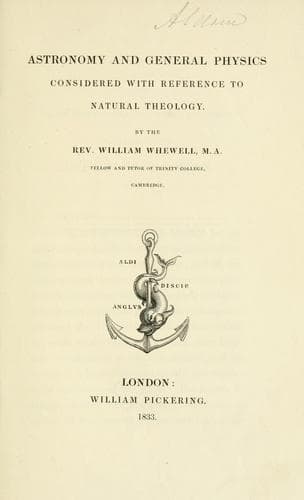
Astronomy and General Physics Considered with Reference to Natural Theology — John Shaqi
Astronomy and General Physics Considered with Reference to Natural TheologyWhewell, William
Religion
Astronomy and General Physics Considered with Reference to Natural Theology
Whewell, William
Astronomy; Cosmic physics; Natural theology
The illustration of this view will be pursued in the succeeding
chapters; and when the coincidence here spoken of is distinctly
brought before the reader, it will, we trust, be found to convey
the conviction of a wise and benevolent design, which has been
exercised in producing such an agreement between the internal
constitution and the external circumstances of organized beings.
We shall adduce cases where there is an apparent relation between
the course of operation of the elements and the course of vital
functions; between some fixed measure of time or space, traced
in the lifeless and in the living world; where creatures are
constructed on a certain plan, or a certain scale, and this plan
or this scale is exactly the single one which is suited to their
place on the earth; where it was necessary for the Creator (if we
may use such a mode of speaking) _to take account_ of the weight
of the earth, or the density of the air, or the measure of the
ocean, and where these quantities are rightly taken account of in
the arrangements of creation. In such cases we conceive that we
trace a Creator, who, in producing one part of his work, was not
forgetful or careless of another part; who did not cast his living
creatures into the world to prosper or perish as they might find it
suited to them or not; but fitted together, with the nicest skill,
the world and the constitution which he gave to its inhabitants;
so fashioning it and them, that light and darkness, sun and air,
moist and dry, should become their ministers and benefactors, the
unwearied and unfailing causes of their well-being.
We have spoken of the mutual adaptation of the organic and the
inorganic world. If we were to conceive the contrivance of the
world as taking place in an order of time in the contriving mind,
we might also have to conceive this adaptation as taking place
in one of two ways: we might either suppose the laws of inert
nature to be accommodated to the foreseen wants of living things,
or the organization of life to be accommodated to the previously
established laws of nature. But we are not forced upon any such
mode of conception, or upon any decision between such suppositions:
since, for the purpose of our argument, the consequence of either
view is the same. There is an adaptation somewhere or other,
on either supposition. There is account taken of one part of
the system in framing the other: and the mind which took such
account can be no other than that of the Intelligent Author of the
universe. When indeed we come to see the vast number, the variety,
the extent, the interweaving, the reconciling of such adaptations,
we shall readily allow, that all things are so moulded upon and
locked into each other, connected by such subtilty and profundity
of design, that we may well abandon the idle attempt to trace the
_order_ of thought in the mind of the Supreme Ordainer.
CHAPTER I.
_The Length of the Year._
Public-domain text, read in full here on John Shaqi.
Reviews
Reviews
No reviews yet
Be the first to share your thoughts on this work.
Join the Discussion
Join the discussion
Sign in to leave a comment or review.
Sign InorCreate an account