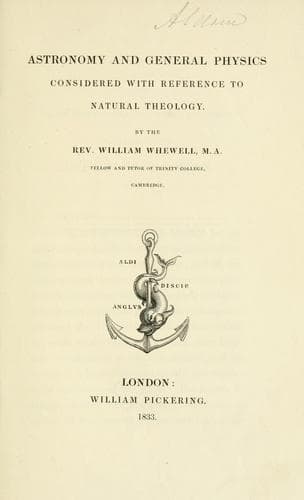
Astronomy and General Physics Considered with Reference to Natural TheologyWhewell, William
Religion
Astronomy and General Physics Considered with Reference to Natural Theology
Whewell, William
Astronomy; Cosmic physics; Natural theology
A year is the most important and obvious of the periods which occur
in the organic, and especially in the vegetable world. In this
interval of time the cycle of most of the external influences which
operate upon plants is completed. There is also in plants a cycle
of internal functions, corresponding to this succession of external
causes. The length of either of these periods might have been
different from what it is, according to any grounds of necessity
which we can perceive. But a certain length is selected in both
instances, and in both instances the same. The length of the year
is so determined as to be adapted to the constitution of most
vegetables; or the construction of vegetables is so adjusted as to
be suited to the length which the year really has, and unsuited
to a duration longer or shorter by any considerable portion. The
vegetable clock-work is so set as to go for a year.
The length of the year or interval of recurrence of the seasons is
determined by the time which the earth employs in performing its
revolution round the sun: and we can very easily conceive the solar
system so adjusted that the year should be longer or shorter than
it actually is. We can imagine the earth to revolve round the sun
at a distance greater or less than that which it at present has,
all the forces of the system remaining unaltered. If the earth were
removed towards the centre by about one-eighth of its distance, the
year would be diminished by about a month; and in the same manner
it would be increased by a month on increasing the distance by
one-eighth. We can suppose the earth at a distance of eighty-four
or a hundred and eight millions of miles, just as easily as at its
present distance of ninety-six millions: we can suppose the earth
with its present stock of animals and vegetables placed where Mars
or where Venus is, and revolving in an orbit like one of theirs: on
the former supposition our year would become twenty-three, on the
latter seven of our present months. Or we can conceive the present
distances of the parts of the system to continue what they are,
and the size, or the density of the central mass, the sun, to be
increased or diminished in any proportion; and in this way the time
of the earth’s revolution might have been increased or diminished
in any degree; a greater velocity, and consequently a diminished
period, being requisite in order to balance an augmented central
attraction. In any of these ways the length of the earth’s natural
year might have been different from what it now is: in the last
way without any necessary alteration, so far as we can see, of
temperature.
Now, if any change of this kind were to take place, the working
of the botanical world would be thrown into utter disorder, the
functions of plants would be entirely deranged, and the whole
vegetable kingdom involved in instant decay and rapid extinction.
Public-domain text, read in full here on John Shaqi.
Reviews
Reviews
No reviews yet
Be the first to share your thoughts on this work.
Join the Discussion
Join the discussion
Sign in to leave a comment or review.
Sign InorCreate an account