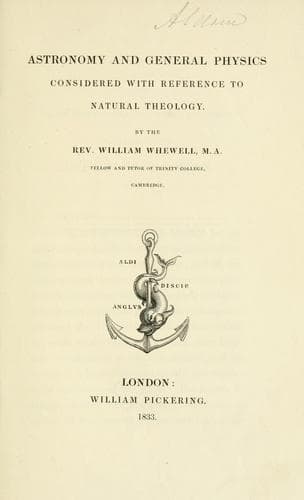
Astronomy and General Physics Considered with Reference to Natural TheologyWhewell, William
Religion
Astronomy and General Physics Considered with Reference to Natural Theology
Whewell, William
Astronomy; Cosmic physics; Natural theology
Thus, Laplace, of whom we have already spoken, as one of the
greatest mathematicians of modern times, expresses his conviction
that the supposed evidence of final causes will disappear as our
knowledge advances, and that they only seem to exist in those cases
where our ignorance leaves room for such a mistake. “Let us run
over,” he says, “the history of the progress of the human mind and
its errors: we shall perpetually see final causes pushed away to
the bounds of its knowledge. These causes, which Newton removed
to the limits of the solar system, were not long ago conceived to
obtain in the atmosphere, and employed in explaining meteors: they
are, therefore, in the eyes of the philosopher nothing more than
the expression of the ignorance in which we are of the real causes.”
We may observe that we have endeavoured to give a very different,
and, as we believe, a far truer view of the effect which philosophy
has produced on our knowledge of final causes. We have shown, we
trust, that the notion of design and end is transferred by the
researches of science, not from the domain of our knowledge to that
of our ignorance, but merely from the region of facts to that of
laws. We hold that, in this form, final causes in the atmosphere
are still to be conceived to obtain, no less than in an earlier
state of meteorological knowledge; and that Newton was right, when
he believed that he had established their reality in the solar
system, not expelled them from it.
But our more peculiar business at present is to observe that
Laplace himself, in describing the arrangements by which the
stability of the solar system is secured, uses language which
shows how irresistibly these arrangements suggest an adaptation
to its preservation as an _end_. If in his expressions we were to
substitute the Deity for the abstraction “nature” which he employs,
his reflection would coincide with that which the most religious
philosopher would entertain. “It seems that ‘God’ has ordered
every thing in the heavens to ensure the duration of the planetary
system, by _views_ similar to those which He appears to us so
admirably to follow upon the earth, for the preservation of animals
and the perpetuity of species.[40] This consideration alone would
explain the disposition of the system, if it were not the business
of the geometer to go further.” It may be possible for the geometer
to go further; but he must be strangely blinded by his peculiar
pursuits, if, when he has discovered the mode in which these views
are answered, he supposes himself to have obtained a proof that
there are no views at all. It would be as if the savage, who had
marvelled at the steady working of the steam engine, should cease
to consider it a work of art, as soon as the self-regulating part
of the mechanism had been explained to him.
Public-domain text, read in full here on John Shaqi.
Reviews
Reviews
No reviews yet
Be the first to share your thoughts on this work.
Elsewhere in the archive
Join the Discussion
Join the discussion
Sign in to leave a comment or review.
Sign InorCreate an account