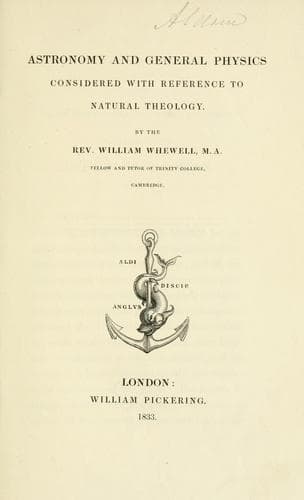
Astronomy and General Physics Considered with Reference to Natural TheologyWhewell, William
Religion
Astronomy and General Physics Considered with Reference to Natural Theology
Whewell, William
Astronomy; Cosmic physics; Natural theology
The unsuccessful struggle in which those persons engage, who
attempt to throw off the impression of design in the creation,
appears in an amusing manner through the simplicity of the ancient
Roman poet of this school. Lucretius maintains that the eye was not
made for seeing, nor the ear for hearing. But the terms in which he
recommends this doctrine show how hard he knew it to be for men to
entertain such an opinion. His advice is,--
Illud in his rebus vitium _vehementer_ et istum
Effugere errorem, vitareque _præmeditator_,
Lumina ne facias oculorum clara creata,
Prospicere ut possimus. iv. 823.
’Gainst their preposterous error guard thy mind
Who say each organ was for use design’d;
Think not the visual orbs, so clear, so bright,
Were furnish’d for the purposes of sight.
Undoubtedly the poet is so far right, that a most “vehement”
caution and vigilant “premeditation” are necessary to avoid the
“vice and error” of such a persuasion. The study of the adaptations
of the human frame is so convincing, that it carries the mind with
it, in spite of the resistance suggested by speculative systems.
Cabanis, a modern French physiological writer of great eminence,
may be selected as a proof of this. Both by the general character
of his own speculations, and by the tone of thinking prevalent
around him, the consideration of design in the works of nature was
abhorrent from his plan. Accordingly, he joins in repeating Bacon’s
unfavourable mention of final causes. Yet when he comes to speak
of the laws of reproduction of the human race, he appears to feel
himself compelled to admit the irresistible manner in which such
views force themselves on the mind. “I regard,” he says, “with the
great Bacon, the philosophy of final causes as barren; but I have
elsewhere acknowledged that it was very difficult for the most
cautious man (l’homme le plus reservé) never to have recourse to
them in his explanations.”[41]
3. It may be worth our while to consider for a moment the opinion
here referred to by Cabanis, of the propriety of excluding the
consideration of final causes from our natural philosophy. The
great authority of Bacon is usually adduced on this subject.
“The handling of final causes,” says he, “mixed with the rest
in physical inquiries, hath intercepted the severe and diligent
inquiry of all real and physical causes, and given men the occasion
to stay upon these satisfactory and specious causes, to the great
arrest and prejudice of farther discovery.”[42]
Public-domain text, read in full here on John Shaqi.
Astronomy and General Physics Considered with Reference to Natural Theology — John Shaqi
Reviews
Reviews
No reviews yet
Be the first to share your thoughts on this work.
Elsewhere in the archive
Join the Discussion
Join the discussion
Sign in to leave a comment or review.
Sign InorCreate an account