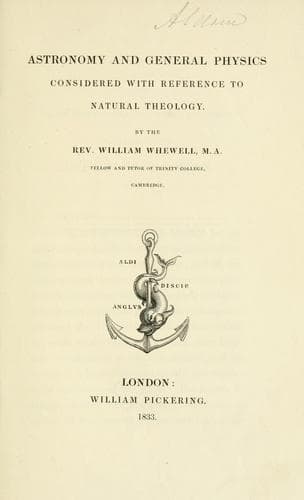
Astronomy and General Physics Considered with Reference to Natural TheologyWhewell, William
Religion
Astronomy and General Physics Considered with Reference to Natural Theology
Whewell, William
Astronomy; Cosmic physics; Natural theology
A moment’s attention will show how well this representation agrees
with that which we have urged, and how far it is from dissuading
the reference to final causes in reasonings like those on which
we are employed. Final causes are to be excluded _from physical
inquiry_; that is, we are not to assume that we know the objects
of the Creator’s design, and put this assumed purpose in the
place of a physical cause. We are not to think it a sufficient
account of the clouds that they are for watering the earth, (to
take Bacon’s examples,) or “that the solidness of the earth is
for the station and mansion of living creatures.” The physical
philosopher has it for his business to trace clouds to the laws of
evaporation and condensation; to determine the magnitude and mode
of action of the forces of cohesion and crystallization by which
the materials of the earth are made solid and firm. This he does,
making no use of the notion of final causes: and it is precisely
because he has thus established his theories independently of any
assumption of an end, that the end, when after all, it returns upon
him and cannot be evaded, becomes an irresistible evidence of an
intelligent legislator. He finds that the effects, of which the
use is obvious, are produced by most simple and comprehensive laws;
and when he has obtained this view, he is struck by the beauty of
the means, by the refined and skilful manner in which the useful
effects are brought about;--points different from those to which
his researches were directed. We have already seen, in the very
case of which we have been speaking, namely, the laws by which the
clouds are formed and distribute their showers over the earth, how
strongly those who have most closely and extensively examined the
arrangements there employed (as Howard, Dalton, and Black) have
been impressed with the harmony and beauty which these contrivances
manifest.
Public-domain text, read in full here on John Shaqi.
Reviews
Reviews
No reviews yet
Be the first to share your thoughts on this work.
Elsewhere in the archive
Join the Discussion
Join the discussion
Sign in to leave a comment or review.
Sign InorCreate an account