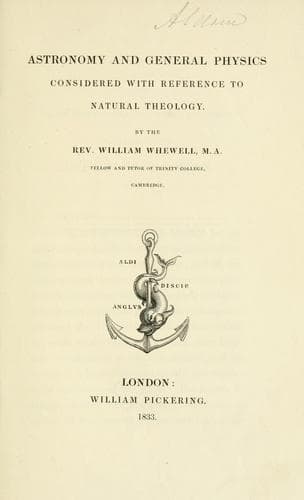
Astronomy and General Physics Considered with Reference to Natural TheologyWhewell, William
Religion
Astronomy and General Physics Considered with Reference to Natural Theology
Whewell, William
Astronomy; Cosmic physics; Natural theology
We may find a further assertion of this view of the proper use of
final causes in philosophy, by referring to the works of one of
the greatest of our philosophers, and one of the most pious of
our writers, Boyle, who has an Essay on this subject. “I am by
all means,” says he, “for encouraging the contemplation of the
celestial part of the world, and the shining globes that adorn it,
and especially the sun and moon, in order to raise our admiration
of the stupendous power and wisdom of him who was able to frame
such immense bodies; and notwithstanding their vast bulk and
scarce conceivable rapidity, keep them for so many ages constant
both to the lines and degrees of their motion, without interfering
with one another. And doubtless we ought to return thanks and
praises to the divine goodness for having so placed the sun and
moon, and determined the former, or else the earth, to move in
particular lines for the good of men and other animals; and how
disadvantageous it would have been to the inhabitants of the earth
if the luminaries had moved after a different manner. I dare not,
however, affirm that the sun, moon, and other celestial bodies
were made solely for the use of man: _much less presume to prove
one system of the world to be true and another false; because the
former is better fitted to the convenience of mankind, or the
other less suited, or perhaps altogether useless to that end_.”
This passage exhibits, we conceive, that combination of feelings
which ought to mark the character of the religious natural
philosopher; an earnest piety ready to draw nutriment from the
contemplation of established physical truths; joined with a
philosophical caution, which is not seduced by the anticipation
of such contemplations, to pervert the strict course of physical
inquiry.
It is precisely through this philosophical care and scrupulousness
that our views of final causes acquire their force and value as
aids to religion. The object of such views is not to lead us to
physical truth, but to connect such truth, obtained by its proper
processes and methods, with our views of God, the master of the
universe, through those laws and relations which are thus placed
beyond dispute.
Public-domain text, read in full here on John Shaqi.
Reviews
Reviews
No reviews yet
Be the first to share your thoughts on this work.
Elsewhere in the archive
Join the Discussion
Join the discussion
Sign in to leave a comment or review.
Sign InorCreate an account