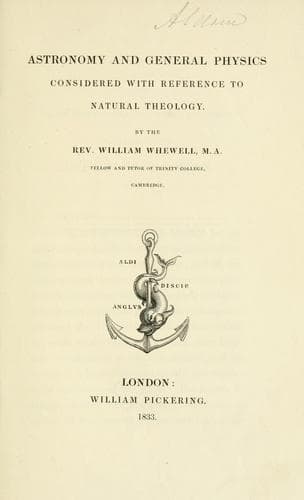
Astronomy and General Physics Considered with Reference to Natural TheologyWhewell, William
Religion
Astronomy and General Physics Considered with Reference to Natural Theology
Whewell, William
Astronomy; Cosmic physics; Natural theology
Bacon’s comparison of final causes to the vestal virgins is one of
those poignant sayings, so frequent in his writings, which it is
not easy to forget. “Like them,” he says, “they are dedicated to
God, and are barren.” But to any one who reads his work it will
appear in what spirit this was meant. “Not because those final
causes are not true and worthy to be inquired, being kept within
their own province.” (Of the Advancement of Learning, b. ii. p.
142.) If he had had occasion to develope his simile, full of latent
meaning as his similes so often are, he would probably have said,
that to these final causes barrenness was no reproach, seeing they
ought to be, not the mothers but the daughters of our natural
sciences; and that they were barren, not by imperfection of their
nature but in order that they might be kept pure and undefiled, and
so fit ministers in the temple of God.
CHAPTER VIII.
_On the Physical Agency of the Deity._
1. We are not to expect that physical investigation can enable us
to conceive the manner in which God acts upon the members of the
universe. The question, “Canst thou by searching find out God?”
must silence the boastings of science as well as the repinings
of adversity. Indeed, science shows us, far more clearly than
the conceptions of every day reason, at what an immeasurable
distance we are from any faculty of conceiving _how_ the universe,
material and moral, is the work of the Deity. But with regard
to the material world, we can at least go so far as this;--we
can perceive that events are brought about, not by insulated
interpositions of divine power exerted in each particular case,
but by the establishment of general laws. This, which is the view
of the universe proper to science, whose office it is to search
out these laws, is also the view which, throughout this work, we
have endeavoured to keep present to the mind of the reader. We
have attempted to show that it combines itself most readily and
harmoniously with the doctrines of Natural Theology; that the
arguments for those doctrines are strengthened, the difficulties
which affect them removed, by keeping it steadily before us. We
conceive, therefore, that the religious philosopher will do well to
bear this conception in his mind. God is the author and governor of
the universe through the laws which he has given to its parts, the
properties which he has impressed upon its constituent elements;
these laws and properties are, as we have already said, the
instruments with which he works; the institution of such laws, the
selection of the quantities which they involve, their combination
and application, are the modes in which he exerts and manifests his
power, his wisdom, his goodness: through these attributes, thus
exercised, the Creator of all, shapes, moves, sustains, and guides
the visible creation.
Public-domain text, read in full here on John Shaqi.
Reviews
Reviews
No reviews yet
Be the first to share your thoughts on this work.
Elsewhere in the archive
Join the Discussion
Join the discussion
Sign in to leave a comment or review.
Sign InorCreate an account