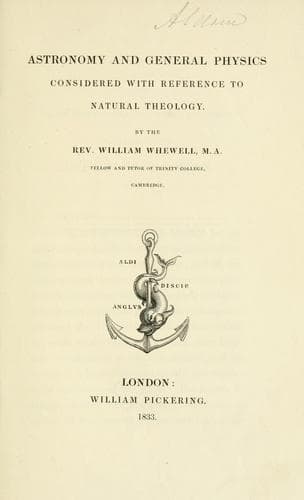
Astronomy and General Physics Considered with Reference to Natural TheologyWhewell, William
Religion
Astronomy and General Physics Considered with Reference to Natural Theology
Whewell, William
Astronomy; Cosmic physics; Natural theology
This has been the view of the relation of the Deity to the universe
entertained by the most sagacious and comprehensive minds ever
since the true object of natural philosophy has been clearly and
steadily apprehended. The great writer who was the first to give
philosophers a distinct and commanding view of this object, thus
expresses himself in his “Confession of Faith:” “I believe--that
notwithstanding God hath rested and ceased from creating since the
first Sabbath, yet, nevertheless, he doth accomplish and fulfil his
divine will in all things, great and small, singular and general,
as fully and exactly by providence, as he could by miracle and
new creation, though his working be not immediate and direct, but
by compass; not violating nature, which is his own law upon the
creature.”
And one of our own time, whom we can no longer hesitate to place
among the worthiest disciples of the school of Bacon, conveys the
same thought in the following passage: “The Divine Author of the
universe cannot be supposed to have laid down particular laws,
enumerating all individual contingencies, which his materials
have understood and obey--this would be to attribute to him the
imperfections of human legislation;--but rather, by creating them
endued with certain fixed qualities and powers, he has impressed
them in their origin with the _spirit_, not the letter of his law,
and made all their subsequent combinations and relations inevitable
consequences of this first impression.”[43]
2. This, which thus appears to be the mode of the Deity’s operation
in the material world, requires some attention on our part in
order to understand it with proper clearness. One reason of this
is, that it is a mode of operation altogether different from that
in which we are able to make matter fulfil our designs. Man can
construct exquisite machines, can call in vast powers, can form
extensive combinations, in order to bring about results which he
has in view. But in all this he is only taking advantage of laws
of nature which already exist; he is applying to his use qualities
which matter already possesses. Nor can he by any effort do more.
He can establish no new law of nature which is not a result of the
existing ones. He can invest matter with no new properties which
are not modifications of its present attributes. His greatest
advances in skill and power are made when he calls to his aid
forces which before existed unemployed, or when he discovers so
much of the habits of some of the elements as to be able to bend
them to his purpose. He navigates the ocean by the assistance of
the winds which he cannot raise or still: and even if we suppose
him able to control the course of these, his yet unsubjugated
ministers, this could only be done by studying their characters, by
learning more thoroughly the laws of air and heat and moisture. He
cannot give the minutest portion of the atmosphere new relations,
a new course of expansion, new laws of motion. But the Divine
Public-domain text, read in full here on John Shaqi.
Reviews
Reviews
No reviews yet
Be the first to share your thoughts on this work.
Elsewhere in the archive
Join the Discussion
Join the discussion
Sign in to leave a comment or review.
Sign InorCreate an account