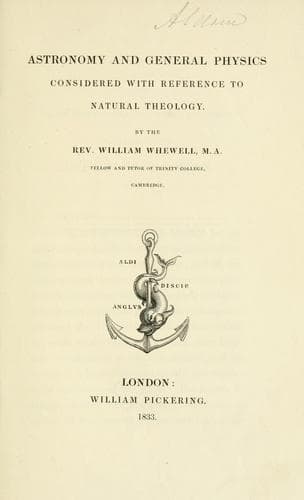
Astronomy and General Physics Considered with Reference to Natural TheologyWhewell, William
Religion
Astronomy and General Physics Considered with Reference to Natural Theology
Whewell, William
Astronomy; Cosmic physics; Natural theology
operations, on the other hand, include something much higher. They
take in the establishment of the laws of the elements, as well
as the combination of these laws and the determination of the
distribution and quantity of the materials on which they shall
produce their effect. We must conceive that the Supreme Power has
ordained that air shall be rarefied, and water turned into vapour,
by heat; no less than that he has combined air and water so as to
sprinkle the earth with showers, and determined the quantity of
heat and air and water, so that the showers shall be as beneficial
as they are.
We may and must, therefore, in our conceptions of the Divine
purpose and agency, go beyond the analogy of human contrivances. We
must conceive the Deity, not only as constructing the most refined
and vast machinery, with which, as we have already seen, the
universe is filled; but we must also imagine him as establishing
those properties by which such machinery is possible: as giving to
the materials of his structure the qualities by which the material
is fitted to its use. There is much to be found, in natural
objects, of the same kind of contrivance which is common to these
and to human inventions; there are mechanical devices, operations
of the atmospheric elements, chemical processes;--many such have
been pointed out, many more exist. But besides these cases of the
combination of means, which, we seem able to understand without
much difficulty, we are led to consider the Divine Being as the
_author of the laws_ of chemical, of physical, and of mechanical
action, and of such other laws as make matter what it is;--and
this is a view which no analogy of human inventions, no knowledge
of human powers, at all assists us to embody or understand.
Science, therefore, as we have said, while it discloses to us the
mode of instrumentality employed by the Deity, convinces us, more
effectually than ever, of the impossibility of conceiving God’s
actions by assimilating them to our own.
Public-domain text, read in full here on John Shaqi.
Reviews
Reviews
No reviews yet
Be the first to share your thoughts on this work.
Elsewhere in the archive
Join the Discussion
Join the discussion
Sign in to leave a comment or review.
Sign InorCreate an account