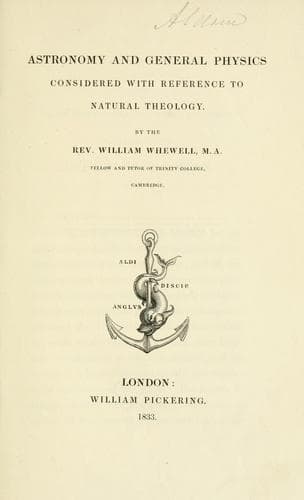
Astronomy and General Physics Considered with Reference to Natural TheologyWhewell, William
Religion
Astronomy and General Physics Considered with Reference to Natural Theology
Whewell, William
Astronomy; Cosmic physics; Natural theology
3. The laws of material nature, such as we have described them,
operate at all times, and in all places; affect every province of
the universe, and involve every relation of its parts. Wherever
these laws appear, we have a manifestation of the intelligence by
which they were established. But a law supposes an agent, and a
power; for it is the mode according to which the agent proceeds,
the order according to which the power acts. Without the presence
of such an agent, of such a power, conscious of the relations
on which the law depends, producing the effects which the law
prescribes, the law can have no efficacy, no existence. Hence we
infer that the intelligence by which the law is ordained, the
power by which it is put in action, must be present at all times
and in all places where the effects of the law occur; that thus the
knowledge and the agency of the Divine Being pervade every portion
of the universe, producing all action and passion, all permanence
and change. The laws of nature are the laws which he, in his
wisdom, prescribes to his own acts; his universal presence is the
necessary condition of any course of events, his universal agency
the only origin of any efficient force.
This view of the relation of the universe to God has been
entertained by many of the most eminent of those who have combined
the consideration of the material world with the contemplation of
God himself. It may therefore be of use to illustrate it by a few
quotations, and the more so, as we find this idea remarkably dwelt
upon in the works of that writer whose religious views must always
have a peculiar interest for the cultivators of physical science,
the great Newton.
Thus, in the observations on the nature of the Deity with which
he closes the “Opticks,” he declares the various portions of the
world, organic and inorganic, “can be the effect of nothing else
than the wisdom and skill of a powerful ever living Agent, who
being in all places, is more able by his will to move the bodies
within his boundless uniform _sensorium_, and thereby to form and
reform the parts of the universe, than we are by our will to move
the parts of our own bodies.” And in the Scholium at the end of
the “Principia,” he says, “God is one and the same God always and
every where. He is omnipresent, not by means of his _virtue_ alone,
but also by his _substance_, for virtue cannot subsist without
substance. In him all things are contained, and move, but without
mutual passion: God is not acted upon by the motions of bodies;
and they suffer no resistance from the omnipresence of God.” And
he refers to several passages confirmatory of this view, not only
in the Scriptures, but also in writers who hand down to us the
opinions of some of the most philosophical thinkers of the pagan
world. He does not disdain to quote the poets, and among the rest,
the verses of Virgil;
Public-domain text, read in full here on John Shaqi.
Reviews
Reviews
No reviews yet
Be the first to share your thoughts on this work.
Elsewhere in the archive
Join the Discussion
Join the discussion
Sign in to leave a comment or review.
Sign InorCreate an account