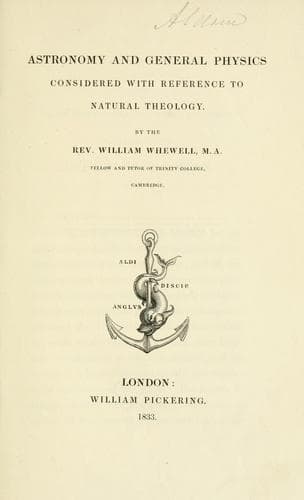
Astronomy and General Physics Considered with Reference to Natural TheologyWhewell, William
Religion
Astronomy and General Physics Considered with Reference to Natural Theology
Whewell, William
Astronomy; Cosmic physics; Natural theology
Principio cœlum ac terras camposque liquentes
Lucentemque globum lunæ, Titaniaque astra,
Spiritus intus alit, totamque infusa per artus
Mens agitat molem et magno se corpore miscet:
warning his reader, however, against the doctrine which such
expressions as these are sometimes understood to express. “All
these things he rules, not as _the soul of the world_, but as the
Lord of all.”
Clarke, the friend and disciple of Newton, is one of those who has
most strenuously put forwards the opinion of which we are speaking,
“All things which we commonly say are the effects of the natural
powers of matter and laws of motion, are indeed (if we will speak
strictly and properly,) the effects of God’s acting upon matter
continually and at every moment, either immediately by himself, or
mediately by some created intelligent being. Consequently there is
no such thing as the course of nature, or the power of nature,”
independent of the effects produced by the will of God.
Dugald Stewart has adopted and illustrated the same opinion, and
quotes with admiration the well-known passage of Pope, concerning
the Divine Agency, which
“Lives through all life, extends through all extent,
Spreads undivided, operates unspent.”
Mr. Stewart, with no less reasonableness than charity, asserts the
propriety of interpreting such passages according to the scope
and spirit of the reasonings with which they are connected;[44]
since, though by a captious reader they might be associated with
erroneous views of the Deity, a more favourable construction will
often see in them only the results of the necessary imperfection
of our language, when we dwell upon the omnipresence and universal
activity of God.
Finally, we may add that the same opinions still obtain the assent
of the best philosophers and divines of our time. Sir John Herschel
says, (Discourse on the Study of Natural Philosophy, p. 37.) “We
would no way be understood to deny the constant exercise of His
direct power in maintaining the system of nature; or the ultimate
emanation, of every energy which material agents exert, from his
immediate will, acting in conformity with his own laws.” And the
Bishop of London, in a note to his “Sermon on the duty of combining
religious instruction with intellectual culture,” observes, “the
student in natural philosophy will find rest from all those
perplexities which are occasioned by the obscurity of causation, in
the supposition, which although it was discredited by the patronage
of Malebranche and the Cartesians, has been adopted by Clarke and
Dugald Stewart, and which is by far the most simple and sublime
account of the matter; that all the events, which are continually
taking place in the different parts of the material universe, are
the _immediate_ effects of the divine agency.”
CHAPTER IX.
Public-domain text, read in full here on John Shaqi.
Reviews
Reviews
No reviews yet
Be the first to share your thoughts on this work.
Elsewhere in the archive
Join the Discussion
Join the discussion
Sign in to leave a comment or review.
Sign InorCreate an account