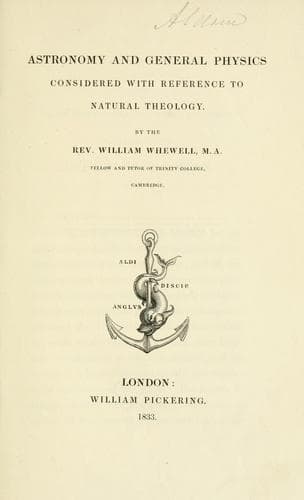
Astronomy and General Physics Considered with Reference to Natural Theology — John Shaqi
Astronomy and General Physics Considered with Reference to Natural TheologyWhewell, William
Religion
Astronomy and General Physics Considered with Reference to Natural Theology
Whewell, William
Astronomy; Cosmic physics; Natural theology
That this would be the case, may be collected from innumerable
indications. Most of our fruit trees, for example, require the year
to be of its present length. If the summer and the autumn were
much shorter, the fruit could not ripen; if these seasons were
much longer, the tree would put forth a fresh suit of blossoms, to
be cut down by the winter. Or if the year were twice its present
length, a second crop of fruit would probably not be matured, for
want, among other things, of an intermediate season of rest and
consolidation, such as the winter is. Our forest trees in like
manner appear to need all the seasons of our present year for their
perfection; the spring, summer, and autumn, for the developement of
their leaves and consequent formation of their _proper juice_, and
of wood from this; and the winter for the hardening and solidifying
the substance thus formed.
Most plants, indeed, have some peculiar function adapted to each
period of the year, that is of the now existing year. The sap
ascends with extraordinary copiousness at two seasons, in the
spring and in the autumn, especially the former. The opening of
the leaves and the opening of the flowers of the same plants are
so constant to their times, (their _appointed_ times, as we are
naturally led to call them,) that such occurrences might be taken
as indications of the times of the year. It has been proposed in
this way to select a series of botanical facts which should form a
calendar; and this has been termed a _calendar of Flora_. Thus, if
we consider the time of putting forth leaves,[1] the honeysuckle
protrudes them in the month of January; the gooseberry, currant,
and elder in the end of February, or beginning of March; the
willow, elm, and lime-tree in April; the oak and ash, which are
always the latest among trees, in the beginning or towards the
middle of May. In the same manner the flowering has its regular
time: the mezereon and snowdrop push forth their flowers in
February; the primrose in the month of March; the cowslip in April;
the great mass of plants in May and June; many in July, August,
and September; some, not till the month of October, as the meadow
saffron; and some not till the approach and arrival of winter, as
the laurustinus and arbutus.
Public-domain text, read in full here on John Shaqi.
Reviews
Reviews
No reviews yet
Be the first to share your thoughts on this work.
Join the Discussion
Join the discussion
Sign in to leave a comment or review.
Sign InorCreate an account