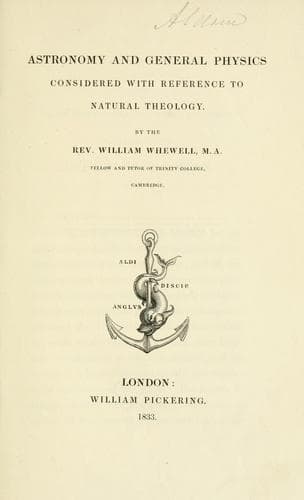
Astronomy and General Physics Considered with Reference to Natural TheologyWhewell, William
Religion
Astronomy and General Physics Considered with Reference to Natural Theology
Whewell, William
Astronomy; Cosmic physics; Natural theology
The same kind of argument might be applied to the animal creation.
The pairing, nesting, hatching, fledging, and flight of birds,
for instance, occupy each its peculiar time of the year; and,
together with a proper period of rest, fill up the twelve months.
The transformations of most insects have a similar reference to the
seasons, their progress and duration. “In every species,” (except
man,) says a writer[3] on animals, “there is a peculiar period of
the year in which the reproductive system exercises its energies.
And the season of love and the period of gestation are so arranged
that the young ones are produced at the time wherein the conditions
of temperature are most suited to the commencement of life.” It is
not our business here to consider the details of such provisions,
beautiful and striking as they are. But the prevalence of the great
law of periodicity in the vital functions of organized beings
will be allowed to have a claim to be considered in its reference
to astronomy, when it is seen that their periodical constitution
derives its use from the periodical nature of the motions of the
planets round the sun; and that the duration of such cycles in the
existence of plants and animals has a reference to the arbitrary
elements of the solar system: a reference which, we maintain, is
inexplicable and unintelligible, except by admitting into our
conceptions; an Intelligent Author, alike of the organic and
inorganic universe.
CHAPTER II.
_The Length of the Day._
We shall now consider another astronomical element, the time of
the revolution of the earth on its axis; and we shall find here
also that the structure of organized bodies are suited to this
element;--that the cosmical and physiological arrangements are
adapted to each other.
We can very easily conceive the earth to revolve on her axis faster
or slower than she does, and thus the days to be longer or shorter
than they are, without supposing any other change to take place.
There is no apparent reason why this globe should turn on its axis
just three hundred and sixty-six times while it describes its orbit
round the sun. The revolutions of the other planets, so far as
we know them, do not appear to follow any rule by which they are
connected with the distance from the sun. Mercury, Venus, and Mars
have days nearly the length of ours. Jupiter and Saturn revolve
in about ten hours each. For any thing we can discover, the earth
might have revolved in this or any other smaller period; or we
might have had, without mechanical inconvenience, much longer days
than we have.
Public-domain text, read in full here on John Shaqi.
Reviews
Reviews
No reviews yet
Be the first to share your thoughts on this work.
Join the Discussion
Join the discussion
Sign in to leave a comment or review.
Sign InorCreate an account