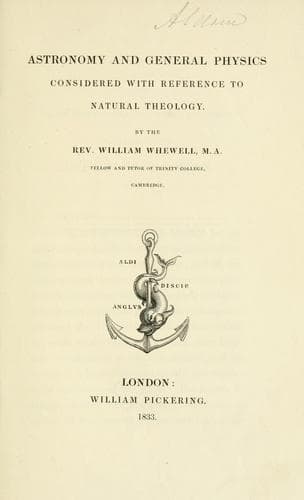
Astronomy and General Physics Considered with Reference to Natural TheologyWhewell, William
Religion
Astronomy and General Physics Considered with Reference to Natural Theology
Whewell, William
Astronomy; Cosmic physics; Natural theology
If, on the other hand, the force of gravity were much lessened,
inconveniences of an opposite kind would occur. The air would be
too thin to breathe; the weight of our bodies, and of all the
substances surrounding us, would become too slight to resist the
perpetually occurring causes of derangement and unsteadiness: we
should feel a want of ballast in our movements.
It has sometimes been maintained by fanciful theorists that the
earth is merely a shell, and that the central parts are hollow.
All the reasons we can collect appear to be in favour of its being
a solid mass, considerably denser than any known rock. If this be
so, and if we suppose the interior to be at any time scooped out,
so as to leave only such a shell as the above mentioned speculators
have asserted, we should not be left in ignorance of the change,
though the appearance of the surface might remain the same. We
should discover the want of the usual force of gravity, by the
instability of all about us. Things would not lie where we placed
them, but would slide away with the slightest push. We should have
a difficulty in standing or walking, something like what we have
on ship-board when the deck is inclined; and we should stagger
helplessly through an atmosphere thinner than that which oppresses
the respiration of the traveller on the tops of the highest
mountains.
We see therefore that those dark and unknown central portions of
the earth, which are placed far beyond the reach of the miner and
the geologist, and of which man will probably never know anything
directly, are not to be considered as quite disconnected with us,
as deposits of useless lumber without effect or purpose. We feel
their influence on every step we take and on every breath we draw;
and the powers we possess, and the comforts we enjoy would be
unprofitable to us, if they had not been prepared with a reference
to those as well as to the near and visible portions of the earth’s
mass.
The arbitrary quantity, therefore, of which we have been treating,
the intensity of the force of gravity, appears to have been taken
account of, in establishing the laws of those forces by which
the processes of vegetable and animal life are carried on. And
this leads us inevitably, we conceive, to the belief of a supreme
contriving mind, by which these laws were thus devised and thus
established.
CHAPTER IV.
_The Magnitude of the Ocean._
Public-domain text, read in full here on John Shaqi.
Reviews
Reviews
No reviews yet
Be the first to share your thoughts on this work.
Join the Discussion
Join the discussion
Sign in to leave a comment or review.
Sign InorCreate an account