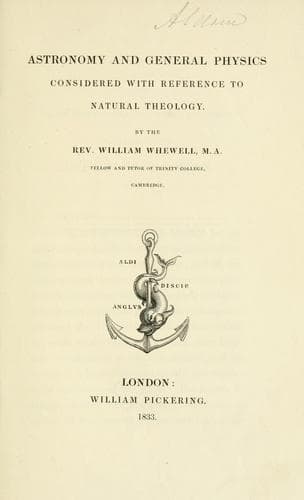
Astronomy and General Physics Considered with Reference to Natural TheologyWhewell, William
Religion
Astronomy and General Physics Considered with Reference to Natural Theology
Whewell, William
Astronomy; Cosmic physics; Natural theology
There are several arbitrary quantities which contribute to
determine the state of things at the earth’s surface besides those
already mentioned. Some of these we shall briefly refer to, without
pursuing the subject into detail. We wish not only to show that
the properties and processes of vegetable and animal life must
be adjusted to each of these quantities in particular, but also
to point out how numerous and complicated the conditions of the
existence of organized beings are; and we shall thus be led to
think less inadequately of the intelligence which has embraced at
once, and combined without confusion, all these conditions. We
appear thus to be conducted to the conviction not only of design
and intention, but of supreme knowledge and wisdom.
One of the quantities which enters into the constitution of the
terrestrial system of things is the bulk of the waters of the
ocean. The mean depth of the sea, according to the calculations of
Laplace, is four or five miles. On this supposition, the addition
to the sea of one-fourth of the existing waters would drown the
whole of the globe, except a few chains of mountains. Whether this
be exact or no, we can easily conceive the quantity of water which
lies in the cavities of our globe to be greater or less than it
at present is. With every such addition or subtraction the form
and magnitude of the dry land would vary, and if this change were
considerable, many of the present relations of things would be
altered. It may be sufficient to mention one effect of such a
change. The sources which water the earth, both clouds, rains,
and rivers, are mainly fed by the aqueous vapour raised from the
sea; and therefore if the sea were much diminished, and the land
increased, the mean quantity of moisture distributed upon the land
must be diminished, and the character of climates, as to wet and
dry, must be materially affected. Similar, but opposite changes
would result from the increase of the surface of the ocean.
It appears then that the magnitude of the ocean is one of the
conditions to which the structure of all organized beings which are
dependent upon climate must be adapted.
CHAPTER V.
_The Magnitude of the Atmosphere._
The total quantity of air of which our atmosphere is composed is
another of the arbitrary magnitudes of our terrestrial system; and
we may apply to this subject considerations similar to those of the
last section. We can see no reason why the atmosphere might not
have been larger in comparison to the globe which it surrounds;
those of Mars and Jupiter appear to be so. But if the quantity of
air were increased, the structure of organized beings would in many
ways cease to be adapted to their place. The atmospheric pressure,
for instance, would be increased, which, as we have already
noticed, would require an alteration in the structure of vegetables.
Public-domain text, read in full here on John Shaqi.
Reviews
Reviews
No reviews yet
Be the first to share your thoughts on this work.
Join the Discussion
Join the discussion
Sign in to leave a comment or review.
Sign InorCreate an account