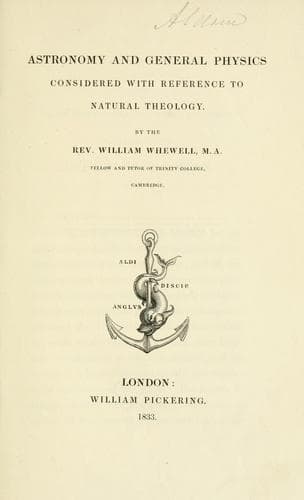
Astronomy and General Physics Considered with Reference to Natural TheologyWhewell, William
Religion
Astronomy and General Physics Considered with Reference to Natural Theology
Whewell, William
Astronomy; Cosmic physics; Natural theology
_The Variety of Organization corresponding to the Variety of
Climate._
The organization of plants and animals is in different tribes
formed upon schemes more or less different, but in all cases
adjusted in a general way to the course and action of the elements.
The differences are connected with the different habits and manners
of living which belong to different species; and at any one place
the various species, both of animals and plants, have a number of
relations and mutual dependences arising out of these differences.
But besides the differences of this kind, we find in the forms of
organic life another set of differences, by which the animal and
vegetable kingdom are fitted for that variety in the climates of
the earth, which we have been endeavouring to explain.
The existence of such differences is too obvious to require to be
dwelt upon. The plants and animals which flourish and thrive in
countries remote from each other, offer to the eye of the traveller
a series of pictures, which, even to an ignorant and unreflective
spectator, is full of a peculiar and fascinating interest in
consequence of the novelty and strangeness of the successive scenes.
Those who describe the countries between the tropics, speak with
admiration of the luxuriant profusion and rich variety of the
vegetable productions of those regions. Vegetable life seems there
far more vigorous and active, the circumstances under which it goes
on, far more favourable than in our latitudes. Now if we conceive
an inhabitant of those regions, knowing, from the circumstances
of the earth’s form and motion, the difference of climates which
must prevail upon it, to guess, from what he saw about him, the
condition of other parts of the globe as to vegetable wealth, is
not likely that he would suppose that the extra-tropical climates
must be almost devoid of plants? We know that the ancients, living
in the temperate zone, came to the conclusion that both the torrid
and the frigid zones must be uninhabitable. In like manner the
equatorial reasoner would probably conceive that vegetation must
cease, or gradually die away, as he should proceed to places
further and further removed from the genial influence of the sun.
The mean temperature of his year being about 80 degrees, he would
hardly suppose that any plants could subsist through a year, where
the mean temperature was only 50, where the temperature of the
summer quarter was only 64, and where the mean temperature of a
whole quarter of the year was a very few degrees removed from that
at which water becomes solid. He would suppose that scarcely any
tree, shrub, or flower could exist in such a state of things, and
so far as the plants of his own country are concerned, he would
judge rightly.
Public-domain text, read in full here on John Shaqi.
Reviews
Reviews
No reviews yet
Be the first to share your thoughts on this work.
Join the Discussion
Join the discussion
Sign in to leave a comment or review.
Sign InorCreate an account