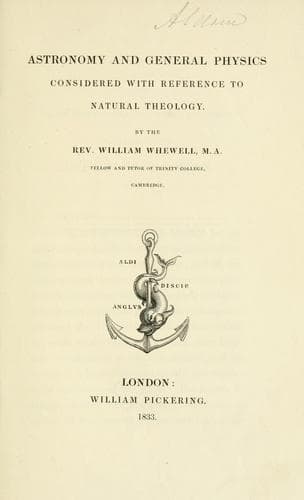
Astronomy and General Physics Considered with Reference to Natural TheologyWhewell, William
Religion
Astronomy and General Physics Considered with Reference to Natural Theology
Whewell, William
Astronomy; Cosmic physics; Natural theology
But the countries further removed from the equator are not left
thus unprovided. Instead of being scantily occupied by such of the
tropical plants as could support a stunted and precarious life
in ungenial climes, they are abundantly stocked with a multitude
of vegetables which appear to be constructed expressly for them,
inasmuch as these species can no more flourish at the equator than
the equatorial species can in these temperate regions. And such
new supplies thus adapted to new conditions, recur perpetually
as we advance towards the apparently frozen and untenantable
regions in the neighbourhood of the pole. Every zone has its
peculiar vegetables; and as we miss some, we find others make their
appearance, as if to replace those which are absent.
If we look at the indigenous plants of Asia and Europe, we find
such a succession as we have here spoken of. At the equator we
find the natives of the Spice Islands, the clove and nutmeg trees,
pepper and mace. Cinnamon bushes clothe the surface of Ceylon; the
odoriferous sandal wood, the ebony tree, the teak tree, the banyan,
grow in the East Indies. In the same latitudes in Arabia the Happy
we find balm, frankincense and myrrh, the coffee tree, and the
tamarind. But in these countries, at least in the plains, the trees
and shrubs which decorate our more northerly climes are wanting.
And as we go northwards, at every step we change the vegetable
group, both by addition and by subtraction. In the thickets to the
west of the Caspian Sea we have the apricot, citron, peach, walnut.
In the same latitude in Spain, Sicily, and Italy, we find the
dwarf palm, the cypress, the chestnut, the cork tree: the orange
and lemon tree perfume the air with their blossoms; the myrtle
and pomegranate grow wild among the rocks. We cross the Alps, and
we find the vegetation which belongs to northern Europe, of which
England is an instance. The oak, the beech, and the elm are natives
of Great Britain: the elm tree seen in Scotland, and in the north
of England, is the wych elm. As we travel still further to the
north the forests again change their character. In the northern
provinces of the Russian empire are found forests of the various
species of firs: the Scotch and spruce fir, and the larch. In the
Orkney Islands no tree is found but the hazel, which occurs again
on the northern shores of the Baltic. As we proceed into colder
regions we still find species which appear to have been made for
these situations. The hoary or cold elder makes its appearance
north of Stockholm: the sycamore and mountain ash accompany us to
the head of the gulf of Bothnia: and as we leave this and traverse
the Dophrian range, we pass in succession the boundary lines of the
spruce fir, the Scotch fir, and those minute shrubs which botanists
distinguish as the dwarf birch and dwarf willow. Here, near to or
within the arctic circle, we yet find wild flowers of great beauty;
the mezereum, the yellow and white water lily, and the European
Public-domain text, read in full here on John Shaqi.
Reviews
Reviews
No reviews yet
Be the first to share your thoughts on this work.
Join the Discussion
Join the discussion
Sign in to leave a comment or review.
Sign InorCreate an account